
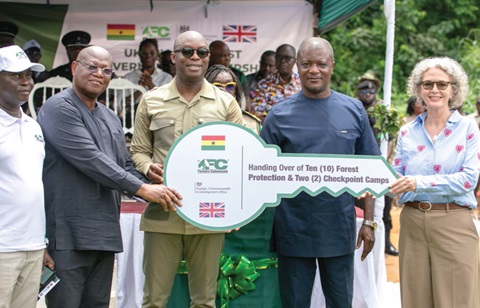
Forestry Commission sets up camps to protect forest reserves
The Forestry Commission has taken a major step towards protecting the country’s forest reserves from further destruction by illegal miners following the inauguration of 10 forest protection camps and two checkpoints at hotspot areas.
The camps, sited at strategic locations on the fringes of the forest reserves, will serve as permanent bases for trained forest guards.
Forest protection camps
Equipped with communication gadgets and weapons, each camp comprises an office, four bedrooms, a fully furnished kitchen, and a place of convenience.
Seven of the camps situated in the Ashanti Region are located at the Mmoframfadwen and Anwiafutu portions of the Offin Shelterbelt Forest Reserve in the Nkawie District; Odaho and Kobro portions of the Apapraman Forest Reserve, as well as the Numereso, Watreso, and Bepotenten sections of the Oda River Forest Reserve in the Bekwai District.
The remaining three in the Western Region are located at Benso, Abrewa Nni Nkran, and Wassa Nkran portions of the Subri River Forest Reserve. The two newly constructed checkpoints are sited in Buru in Kintampo and Maluwe, near Wa.
A ceremony was held at the Oda River Forest Reserve, near Numereso in the Amansie Central District in the Ashanti Region, last Tuesday to symbolically inaugurate all the camps and checkpoints.
The forest protection camps have been set up as part of a strategic partnership between the government of the United Kingdom (UK), through its Foreign Commonwealth and Development Office (FCDO), and the Ghana government, through the Forestry Commission.
The partnership, which took effect from December last year, is meant to improve forest governance in the country by bolstering security to curb encroachment activities by illegal miners and other environmental criminals.
The timely intervention, through the support of the UK government, seeks to strengthen the capacity of the commission to deliver on its mandate of protecting, developing, and sustainably managing Ghana’s forests and wildlife resources.
Context
Although forests provide useful ecological and climate services to humans, the country’s 288 forest reserves have been under threat by illegal miners and other environmental criminals who destroy the forest landscape in search of gold, timber, and game.
As of February this year, the latest scientific study by the Forestry Commission revealed that a whopping 8,923.8 hectares of the country's forest reserves, equivalent to 12,500 FIFA-standard football fields, had been heavily impacted by illegal mining activities.
The findings of the national satellite remote-sensing-based verification of mined-out areas in forest reserves revealed that the affected areas encompassed 45 forest reserves and a national park as of December 31, 2024.
Additionally, forest guards who have been trained to protect the forest reserves continue to suffer brutal attacks in the line of duty by the criminal elements.
Records from the Forestry Services Division (FSD) show that 34 field officers sustained life-threatening injuries from dastardly attacks by illegal miners over the past five years.
Daily Graphic's checks at the Forestry Commission revealed that between 2017 and now, 23 staff from the Wildlife Division had either been killed or maimed by poachers and illegal chainsaw operators.
Specifically, the statistics revealed that four resource guards were killed by poachers, 19 others severely attacked, with some still battling for their lives.
It is against this backdrop that the forest camps were set up to guarantee the safety of forest guards and also protect the ecological integrity of the forest landscape.
Operational capacity
The Chief Executive of the Forestry Commission, Dr Hugh C.A. Brown, described the inauguration of the protection camps as a key milestone in the Commission’s comprehensive approach to forest protection.
He said apart from enhancing the commission’s operational capacity, the camps marked a paradigm shift in the way forest reserve protection was undertaken in the country.
“We are moving away from the era where a single forest guard lives in a rented range community to one living in a camp with his colleagues and working in teams. Indeed, there is strength and synergy in numbers,” he said.
Dr Brown added that the setting up of the protection camps was “a bold statement to all that the government and its partners are serious and walking the talk to stem the menace of illegal mining, logging, and other crimes.”
Commitment
The acting Deputy British High Commissioner to Ghana, Dr Terri Sarch, said the setting up of the forest protection camps was a clear demonstration of Ghana’s commitment to strengthening forest protection on the ground.
She stressed that a stronger frontline, improved coordination, and better facilities were essential if the threats to forest protection were to be addressed effectively.
“The camps stand as a testament to the people who work tirelessly to protect Ghana’s forests, and it also symbolises our shared commitment to forest conservation,” she said.
Dr Sarch reiterated the UK’s commitment to working with Ghana to strengthen forest protection and support sustainable forestry.
Collaboration
In a speech delivered on his behalf, the Minister of Lands and Natural Resources, Emmanuel Armah-Kofi Buah, admitted that the country’s forestry sector was under siege and needed aggressive efforts to curb the situation.
The Chairman of the Forestry Commission Board, Isaac Essien, who delivered the minister’s speech, stressed that defending the forests from criminal elements required constant, visible and rapid response.
“We cannot fight modern forest crimes from offices in the cities far away from the reserves,” he stressed.
Mr Buah said the protection camps would ensure that there was a permanent and tactical presence of Forestry Commission’s field officers inside and near the forest reserves.
Again, he said the move was meant to send a clear message to eco-criminals that forest reserves were “no longer easy targets.”
He commended the UK government for supporting Ghana’s broader efforts in addressing environmental challenges.
Support
For his part, the District Chief Executive (DCE) for Amansie Central, Emmanuel Obeng Agyemang, urged the Forestry Commission to jealously guard the camp in the area to stand the test of time.
He further entreated the people to support the forest guards to protect the forest reserve for the benefit of unborn generations.
The Twafohene of Bekwai, Nana Boampem Benko II, urged the government to intensify efforts to protect the country’s forest reserves from destruction, particularly by illegal miners.
He said the livelihoods of many Ghanaians depended on forests, for which reason everything possible must be done to preserve them.
