
Ghana has first Marine Protected Area - Veep calls for commitment towards its success
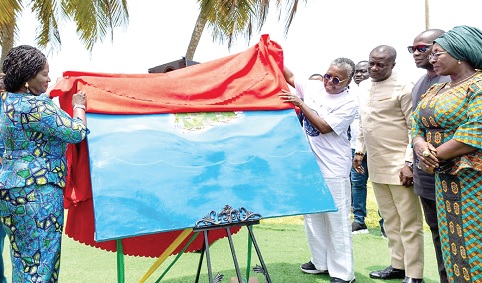
The Vice-President, Prof. Naana Jane Opoku-Agyemang, has formally declared Ghana's Marine Protected Area (MPA) at the Greater Cape Three Points area in the Western Region, describing it as Ghana's bold step towards marine resource conservation.
She said the declaration was firmly anchored on the Fisheries and Aquaculture Act 1146 and other international protocols on marine and environmental conservation to which Ghana was a signatory, stressing that the declaration reinforces Ghana's position in international ocean conservation.
"The government has chosen to act boldly, and the marine protected area that we declare today is a critical measure in our national strategy," the Vice-President emphasised.
Event
The ceremony held at Busua in the Western Region was attended by a blend of policymakers, academia, civil society groups, traditional authorities, fisherfolk and representatives of the 21 communities in the MPA's catchment area.
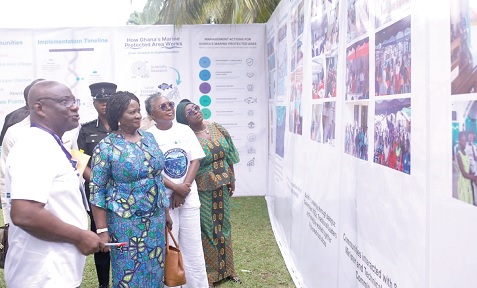
Prof. Naana Jane Opoku-Ageymang (2nd from left), Vice-President, and Emelia Arthur (2nd from right), Minister of Fisheries and Aquaculture, and other dignitaries inspecting an exhibition of the activities and processes leading to the establishment of the MPA
It was also attended by the ministers of Tourism and Creative Art, Lands and Natural Resources, Environment Science and Technology, Innovation, and Chieftaincy and Religious Affairs, who variously pledged commitment to the success of the MPA.
Necessity
Vice-President Opoku-Agyemang indicated that Ghana's marine resources held great potential to promote food security, enhance livelihood and eco-tourism for sustainable development.
She said the MPA's establishment had become crucial as fisheries resources had been depleted by overfishing, habitat destruction, pollution and other illegal, unregulated and unreported activities, saying these must stop.
She further intimated that scientific evidence was clear and deeply concerning that marine resources were on the decline, with far-reaching consequences for food security and the socio-economic fabric of the coastal communities.
The Vice-President stressed that the MPA was a bold national strategy to protect the marine resources, saying the demarcated area, which had unique coral reefs and a migratory corridor for marine animal species, was found to be the most economically significant area along Ghana's coastline.
Prof. Opoku-Agyemang stressed that the MPA declaration was not a total ban on fishing nor a closure of the sea to those who depended on it, emphasising that fishing communities would continue to have access to sections of the area.
She stated that the MPA was a tool for rebuilding and sustaining the fisheries, saying Ghana had adopted a combination of tools to help replete stock to help the ocean recover, regenerate and thrive.
"When Marine Protected Areas are encouraged, and effectively fish rebound, catches improve and coastal communities prosper," she stated.
Prof. Opoku-Agyemang said: "Our fishing communities are central to our history, economy, identity and future. Protecting the ocean means we are protecting our people and indeed, that we are protecting ourselves," she stated.
She commended marine biologists, indigenous authorities and civil society organisations for their efforts towards the successful establishment of the MPA.
Collaboration
The Vice-President reaffirmed the government’s determination to protect Ghana’s marine resources through responsible management and collaboration with coastal communities.
She urged fishermen, traditional leaders and residents to support the initiative and adopt sustainable fishing practices to ensure the long-term survival of the fisheries sector and the well-being of future generations.
The Minister of Fisheries and Aquaculture, Emelia Arthur, acknowledged the contributions of the various stakeholders, particularly Hen Mpoano, to the establishment of the MPA, saying the MPA declaration was the beginning of greater efforts towards preserving and conserving the marine resources.
Support, sustainability
The Director of Hen Mpoano, Kofi Agbogah, said the organisation was committed to ensuring the marine resources were conserved for posterity.
He said the organisation had undertaken several stakeholder engagement and put in place livelihood support to ensure the communities in the catchment areas were mitigated.
The President of the Ghana National Canoe Fishermen Council, Nana Joojo Solomon, urged the government to ensure that fishermen and fisher communities were supported with livelihoods that would earn them dignified, sustained incomes to make the establishment of other MPAs easier.
The Paramount Chief of the Essikado Traditional Area, Nana Kobina Nketiah V, called for stronger collaboration among all stakeholders to foster ownership and the success of the MPA.
