
Ghana’s first forest protection strategy in the offing
A committee of experts has been set up to develop a comprehensive Forest Protection Strategy that provides a clear national blueprint for protecting the forest ecosystem from destruction.
Set up by the Forestry Commission, the multi-stakeholder expert group has been tasked to, within a maximum of one year, develop “a forward-looking, and action-oriented strategy” that would reposition forest protection at the centre of national development.
Additionally, the team of experts is required to provide mechanisms for leveraging technology to deal with criminal elements who were intruding on forest reserves.
The 13-member committee is chaired by the Director of Operations - Natural Forest, at the Forest Services Division of the Forestry Commission, Yaw Kwakye.
The members of the committee were drawn from institutions such as the National House of Chiefs (NHC), the Ministry of Lands and Natural Resources, the Forestry Research Institute of the Council for Scientific and Industrial Research (CSIR), various divisions of the Forestry Commission, academia and civil society organisations (CSOs) in the forestry sector.
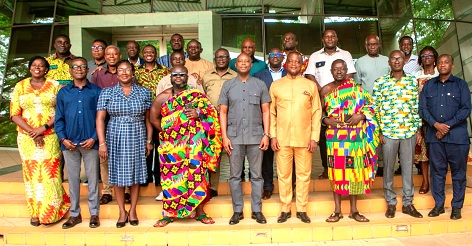
The Chairman of the Forestry Commission Board, Isaac Essien, inaugurated the group last Friday.
Context
Forests provide critical ecosystem services to humanity, including water and climate benefits.
Over the past two decades, the country's forest reserves have come under severe pressure from illegal mining, illegal logging, encroachment, wildfires, infrastructure expansion, weak land-use planning, and increasing disregard for forest laws.
In some cases, organised criminal networks and armed groups have openly challenged state authority within forest reserves.
The latest scientific study by the Forestry Commission revealed that a whopping 8,923.8 hectares of the country's forest reserves, equivalent to 12,500 FIFA standard football fields, have been heavily impacted by illegal mining activities.
The findings of a national satellite remote-sensing-based verification of mined-out areas in forest reserves, released by the Commission on February 24, this year, revealed that the affected areas encompassed 45 forest reserves and a national park as of December 31, 2024
It is against that backdrop that the commission constituted the multi-stakeholder team to develop a strategic plan that would guide the protection of the country’s forest landscape.
Crux of the matter
The Chief Executive Officer (CEO) of the Forestry Commission, Dr Hugh Brown, explained to the Daily Graphic that the move to develop the forest protection strategy was critical because, beyond helping to guard against deforestation and forest degradation, it would make provisions to deal with criminal elements who were undertaking lawless activities in the forest landscape.
Dr Brown explained that after many years of using the current system for forest management, there was a need to switch to a strategy that responded appropriately to the emerging challenges of this time.
For instance, he explained that currently, the commission had a manual of procedures for dealing with wildfires, for setting up Globally Significant Biodiversity Area (GSBA) and for selecting areas that needed to be kept out of production.
However, he said those manuals were separate, and the commission did not have a comprehensive document that helps us to deal with organised criminal activities in the forest.
"Quite a number of our forest reserves also form part of our international boundaries with Cote d’Ivoire, Burkina Faso, Togo and if we are unable to protect them, we may have intrusion of terrorists.
“That is why the issue of surveillance and being able to identify and nip problems in the bud early is one of the key tasks of this committee," he stressed.
Key milestone
Mr Essien described the inauguration of the committee as "the beginning of a deliberate national effort to safeguard one of Ghana’s most valuable natural assets — our forests".
He stressed that the development of a robust strategic plan for forest protection was critical because there was an intricate link between sustainable national development and a healthy forest.
The chairman of the expert group, Mr Kwakye, said the duty was onerous, but the team of experts was up to the task and gave the assurance that the team would work diligently to deliver on their mandate within 12 months.
