
Govt shifts focus to early numeracy - President cites basic education failures for poor WASSCE results
President John Dramani Mahama has linked the recent decline in candidates’ performance in the West African Senior School Certificate Examination (WASSCE) to what he describes as “long-standing weaknesses in basic education”, and announced a government priority shift towards early literacy and numeracy.
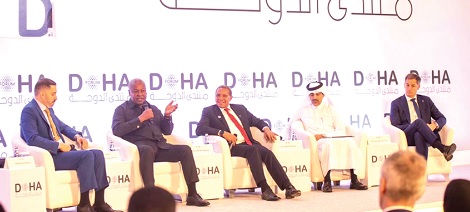
At the Doha Forum 2025 yesterday, the President said the country must turn its attention to foundational learning to correct the gaps that had made progress at the secondary level difficult.
“There has been a bit of neglect at the basic level, and so we are going to return to foundational learning, getting the children to master the three Rs – reading, writing and arithmetic.
“We noticed that if you have a weak basic foundation, when you get to the secondary, it's very difficult for the child to catch up”.
“You need to see it in the results that are coming out of the West African secondary school education.
There's weakness in mathematics, writing and proper construction of sentences,” President Mahama said yesterday during the panel discussion on “Economic Empowerment in Africa, Pathway to Inclusive Prosperity” at the 2025 Doha Forum underway in Qatar.
He said spending at the secondary level of education had grown at the expense of basic schools, adding that the imbalance had weakened the foundation many pupils needed to succeed.
“We're looking at how we can spread resources to get a better outcome.
One of the places that expends most of our funding in education is the secondary level,” President Mahama, who also delivered the opening remarks at the Education as Justice session of the forum, stated.
TVET focus
President Mahama said his administration would revamp the country’s education system, with a focus on foundational learning and technical, vocational and educational training (TVET) to address the challenge of producing graduates who do not meet industry demands.
He indicated that the current education system, inherited from the British, placed too much emphasis on academic achievement, rather than practical skills.
President Mahama stated that in contemporary times, captains of industry required more middle-level technicians, rather than graduates in business administration or the humanities.
The President said a shift towards TVET, which would equip students with the skills needed by industry, was more desirable and a direct response to the challenge faced by the education system.
Education funding
President Mahama also touted the country’s mechanism to domestically fund its own education, as global partners’ desire to fund education programmes has shifted over the years.
He cited the introduction of a 2.5 per cent value-added tax (VAT) and additional budgetary allocation, which have enabled the country to meet its 20 per cent target for education funding.
“Ghana has performed well in terms of its mandatory allocation to education because at a point in time, we realised that education was the key sector to Ghana's progress and development.
“As a nation, we took a decision that we will all contribute to everything we purchase, a 2.5 per cent value-added tax that goes into what we call the Ghana Education Trust Fund.
That fund alone is able to mobilise sufficient revenue to almost hit the 20 per cent mark.
“So, additional allocation from the national budget makes us easily overcome the 20 per cent target,” he said.
He urged other countries to explore similar approaches to ensure sustainable funding for education rather than relying on external funding for their education programmes.
President Mahama said with the dwindling external funding for education and development programmes, African countries needed to reconsider their funding models for education programmes.
"While we rely on boosting education in the developed countries through these kinds of mechanisms, we must look locally at mechanisms that enable us to contribute to our own children's education," he said.
