
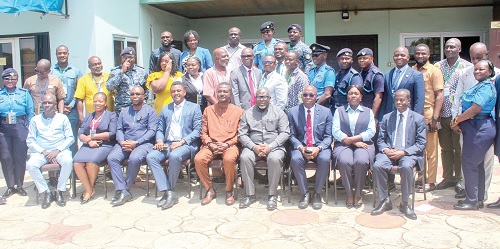
GRA prioritises staff welfare to drive productivity, revenue growth
The Commissioner-General of the Ghana Revenue Authority (GRA), Anthony Kwasi Sarpong, has reaffirmed the GRA’s commitment to improving the welfare of its staff to achieve its mandate of revenue mobilisation.
He explained that the GRA was working to address staff concerns, including welfare, training and career development, while investing in the well-being of its workforce of more than 10,000, describing them as its most valuable resource.
He, however, urged employees to adhere to the GRA’s Code of Ethics and Conduct to help promote professionalism across its offices.
Mr Sarpong was speaking at the 12th National Executive Council meeting of the GRA Workers’ Union (GRAWU) held in Accra on the theme: “Transforming for Impact and Growth-The Role of Labour in Strengthening the Work”.
The two-day meeting was aimed at creating a platform for stakeholders to deliberate on strategies to improve work ethics, enhance staff welfare and strengthen the Authority’s capacity to meet its revenue targets.
Strategy implementation
The Commissioner-General said the GRA had set for itself an ambitious “360 by 28” agenda to raise about GH¢360 billion in domestic revenue by 2028.
He said the GRA’s performance over the past two years has demonstrated steady progress towards that goal, mobilising GH¢153 billion in 2024 and GH¢182 billion in 2025, representing a growth of GH¢29 billion.
Despite falling short of its 2025 target of GH¢189 billion, he said the GRA still achieved 96 per cent of its goal, which showed a strong indication of its capacity to deliver.
He added that the government had set a higher target of GH¢225 billion for the GRA, representing an increase of GH¢43 billion over the 2025 performance.
He mentioned that the GRA has developed actionable strategies to boost revenue mobilisation, which include investment in technology to improve efficiency and plug revenue leakages.
Additionally, he said the Authority had been working to automate its domestic revenue collection system through the Integrated Tax Administration System (ITAS), which is expected to go live on April 1, 2026.
On enforcement, he said the GRA was intensifying efforts to combat smuggling by collaborating with national security and other agencies to clamp down on illegal activities across land borders and within the petroleum sector.
The Board Chairman of the GRA, Kweku George Ricketts-Hagan, reiterated the critical role of discipline, professionalism and collaboration in strengthening revenue mobilisation.
He said reliance on domestic revenue was key to reducing the country’s dependence on borrowing.
“With the right people, the right systems and the right technology, we can build a first-class revenue institution, not only in Ghana but across sub-Saharan Africa,” he stressed.
Unlawful directives
For his part, the National Chairman of GRAWU, Theophilus Kwesi Ehun, reiterated the union’s position against unlawful directives, cautioning officers not to act on verbal instructions often referred to as “orders from above.”
“Under no circumstances should any officer act on such instructions.
Any directive must be properly documented within the system,” he stressed.
He expressed concern over unresolved issues relating to office accommodation, particularly the use of the GRA’s Kanda building by the Ministry of Finance.
He indicated that the union had issued formal communications to management and the relevant authorities, demanding the fulfilment of agreed conditions.
The national chairman said failure to address the concerns could lead to industrial action, although he expressed hope that dialogue would prevail.
“Our work is critical to the nation, but we will not sit unconcerned when our toil and sweat have been used in putting up a building the ministry has contributed zero to,” he said.
