
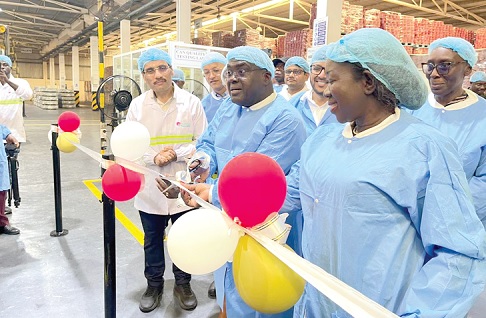
Industrial growth should transcend politics — Julius Debrah
The Chief of Staff, Julius Debrah, has underscored the need for industrial growth to go beyond partisan considerations, stressing that national development must remain a collective priority irrespective of which political party is in power.
He said effective industrial growth depended on consistent policies and support from both the government and private sector, not on which political party was in power, adding that if factories and investors received the right incentives and policies, their operations—and by extension, national development—should continue smoothly regardless of political changes
He made the remarks after leading a government delegation to Nutrifoods Ghana Limited to familiarise themselves with operations at the company’s production facilities.
The team included the Minister of Trade, Agribusiness and Industry, Elizabeth Ofosu-Adjare, and the Presidential Envoy for Interfaith and Ecumenical Relations, Elvis Afriyie Ankrah.
“It's not about NDC, NPP. Imagine we have hundreds of such factories in Ghana.
There are people who are going to ask, are you an NPP person or NDC person? So no matter who is in power, if they come out with a policy and it will make sense, let's all support it,” he stressed.
During the visit, the Chief of Staff also commissioned the upgraded canmaking line with an investment value of more than US $500,000 at the culinary plant in the Tema Industrial Area.
24-hour economy
Mr Debrah commended Nutrifoods, a joint venture between Olam and Sanyo, for its high manufacturing standards, impressive safety protocols and commitment to local sourcing, describing the visit as “very informative, educative and productive.”
He emphasised that the company’s operations provided a practical model for President John Dramani Mahama’s 24-hour economy agenda, pointing out that Nutrifoods had already instituted multiple production shifts, and sourced most of its inputs locally.
He further revealed that the government was developing incentives under a new Accelerated Export Drive Bill to encourage private investment in manufacturing and agro-processing, particularly those aligned with the 24-hour production policy.
“When you have business people, investors coming to your country and you don't give them the incentives or the support they need to enable them to operate freely, there will be capital flights because everybody wants to go to where they'll be more comfortable,” he said.
Raw material
Touching on raw material supply, Mr Debrah called for improved coordination across the value chain to ensure consistency in local sourcing, citing tomatoes and other key produce as examples.
He stressed that the government’s comprehensive value addition strategy sought to end the export of raw agricultural materials to strengthen local industries.
High standards, job creation
The Managing Director and Business Head of Nutrifoods Ghana Limited, Jay Anjaria, stated that the upgraded can-making line also reinforced the company’s contribution to the Government’s Investment in the nation’s initiative which promoted local industrial growth.
He emphasised Nutrifoods’ commitment to global food safety and quality standards across both manufacturing plants.
“At Nutrifoods, we adopt world-class standards for efficient and responsible production.
We hold ourselves to the highest quality benchmarks in developing home-grown brands that meet the needs of the Ghanaian market.
Our products are proudly Ghanaian nurtured from ideation to execution.
Born in Ghana, made for Africa,” he stated.
Mr Anjaria also highlighted Nutrifoods’ commitment to job creation and continued investment in building the intellectual and technical capacity required to support the future of manufacturing excellence in the country.
“Such engagements give us a lot of solace that the government is there listening to us.
We are completely committed to the 24-hour economy.
We are already there.
“We have been discussing the Big Push which is happening.
Great roads means faster transport, reduced accidents, reduced fuel usage, reduced costs and we want to make Ghana the hub for West Africa,” he said.
