
Intensify advocacy to deal with maternal mental health stigma — Dr Brightson
The Technical Advisor to the Vice-President on Health, Dr Kennedy T. C. Brightson, has called for incessant advocacy on maternal mental health to create awareness of the condition and make it acceptable to society.
He attributed the increased stigma to some socio-cultural and religious practices and said those customs were affecting the condition.
“We need to speak out, we need to talk about it, and we need planned radio and television programmes to make people aware that this is a condition that may happen in pregnancy or after childbirth. When it happens, we should seek appropriate help and not attribute it to the devil,” he added.
Dr Brightson, who was speaking on the sidelines of a stakeholder meeting on advancing maternal mental health in Accra yesterday, said people did not seem to understand the mechanism of childbirth, hence the increased stigma for this category of expectant mothers.
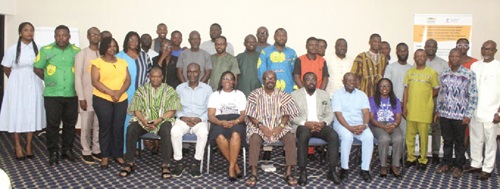
The meeting was organised by BasicNeeds -Ghana, with support from the Christian Health Association of Ghana (CHAG) and the Ghana Health Service, among other NGOs.
Supported with funding from Expertise France Groupe, the meeting seeks to advance maternal mental health in HIV/TB response among perinatal women and adolescent girls living with or at risk of HIV, TB and Gender Based Violence (GBV).
Dr Brightson said understanding the mechanism of childbirth did not necessarily mean looking at the processes through which a child was born, but holistically understanding women as well as the stress women went through, especially when they marry and within a year, there is no pregnancy.
“Everybody looks at the woman and not the man. So there is already stress, and not every woman goes through pregnancy easily.
The process of childbirth itself is very stressful, and some women are unable to handle the stress, so at that high level of stress after childbirth, it begins to weigh them down; it touches on their mental health status,” he explained and said when that happened, it did not mean that the woman had a problem that could not be solved.
Prayer camp
Having worked in the clinic for so many years, Dr Brightson who is a director in charge of family health at the Ghana Health Service (GHS), explained that, “the experience is that we do not understand what happens to a woman when she gives birth because once birth has occurred and there is a challenge, sometimes the first place she is rushed to is the prayer camp.”
He said, “A prayer camp may not understand the dynamics that the woman is going through, so they put a big chain on her leg and tie her to a tree and begin to cast the devil, but then the more you do that, the more precarious the condition of the woman becomes because that is not treatment, that is subjecting her to cruelty.”
A World Health Organisation (WHO) Technical Officer for Mental Health, Dr Levena Gyimah, thanked the participants for their continued commitment to strengthening community health systems as well as advancing integrated, people-centred care in the country.
She said the project reflected a shared understanding that health challenges were interconnected and that effective response must address physical, mental and social well-being together, particularly for those facing multiple forms of vulnerability.
For his part, the Executive Director of BasicNeeds-Ghana, Dr Peter Bedimak Yaro, said the project was hinged on community health systems strengthening approach to maximise existing available resources.
That, he said, was to strengthen shared tasks, improve referral linkages and deepen community and lived experience participation in health care.
He was hopeful that the government, through the GHS and the Mental Health Authority (MHA), as well as the relevant ministries, agencies and departments, would prioritise the initiative.
