
Interior, Education ministries, Prisons sign MoUs ...For production of sanitary pads, uniforms, furniture
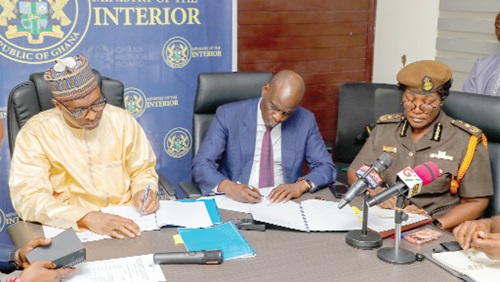
The Ministry for the Interior and the Ministry of Education have signed three memoranda of understanding (MoUs) for the production of sanitary pads, uniforms and furniture by the Ghana Prisons Service for schools in the country.
The initiative is a deliberate policy choice by the government to integrate education delivery, local production, value for money procurement, and correctional rehabilitation into a single coherent national intervention.
At a ceremony in Accra yesterday to formalise the collaboration, the Minister for the Interior, Muntaka Mohammed-Mubarak, and the Minister of Education, Haruna Iddrisu, signed for their outfits, with the Director-General of the Ghana Prisons Service, Patience Baffoe-Bonnie, initialling for the institution.
Muntaka
Mr Mohammed-Mubarak said each of the MoUs provided for a defined duration, structured implementation arrangement, and mid-term review at the 18th-month mark.
The review mechanisms, he said, were critical and that “they will allow us to assess performance and address operational challenges and refine delivery models to ensure that intended outcomes are achieved.”
First, the minister said the Memorandum of Understanding on the minimum 30 per cent concession for the production and supply of school furniture assigned to the Ministry for the Interior through the Ghana Prisons Service, was a clear role in the manufacture of desks, chairs, teachers’ tables, and related furniture.
That arrangement, he said, would support timely supply, quality assurance, and equitable distribution in collaboration with education sector agencies.
Concession
Second, he said the MoU on the minimum 25 per cent concession for the implementation of the government's 2025 Free Sanitary Pad distribution initiative reflected the government's commitment to girls' education, dignity, and retention in school.
“Leveraging the productive capacity of the Ghana Prisons Service for this initiative strengthens both social protection and outcomes in local manufacturing. The last Memorandum of
Understanding on the minimum 30 per cent concession for the production and supply of school uniforms, addresses long-standing shortages in approved school clothing and accessories,” he said.
“Through this framework, uniforms will be produced locally, distributed transparently, and aligned with national education logistics planning. Ladies and gentlemen, this Memorandum of Understanding delivers multiple interlinked outcomes.
They ensure value for money and transparency in public procurement by anchoring production within state-owned industrial systems subject to clear oversight,” he said.
Initiative
Mrs Baffoe-Bonnie said the initiative was a dream come true and a game-changer as far as the Ghana Prisons Service was concerned.
“In the days past, the perception was that the Ghana Prisons Service was just there locking up inmates and releasing them to the community when it became necessary.
“But today the opportunity has come for the service to make itself relevant in the scale of production and making the Ghana Prisons Service very useful, and in doing so, we are going to rely on the inmates who will be taken through skill training, and in this particular case the emphasis is going to be on managing machines in the sanitary production,” she said.
“We are poised for the engagement, and special thanks to the minister for education.
A year from now, when we meet around this table, we will be discussing our profit trends, and I know it is a dream come true,” she said.
Local economy
The Education Minister described the collaboration as ‘President Mahama Indigenous Local Industry Initiative’ of trying to grow the local economy.
He said it was possible for one of the manufacturers or producers to situate their productive entity within their prisons and to use the labour and skills of prisoners to get this out.
The total quantity of sanitary pads supplied for 2025, he said, was in the region of 12 million and more, and that he was scaling that up to about 15 and 20 million.
“We definitely will find some budget line to support the Ghana Prisons to undertake the production of the sanitary pads. So into 2026, we will be mindful and guided by this memorandum of understanding when we are undertaking the procurement,” he said.
Mr Iddrisu said for furniture, the President had cautioned against the use of wood.
“President again cautioned that he doesn't want Ghana to continue relying on wood. So be guided that we want furniture, but not furniture produced out of wood.
As much as practicable and possible, maybe we can use plastics and other wastes to be able to generate furniture for that purpose,” he said.
“With uniforms, if we manage it well, we can add sports; the sports dresses they wear for purposes of physical training and physical exercise.”
