
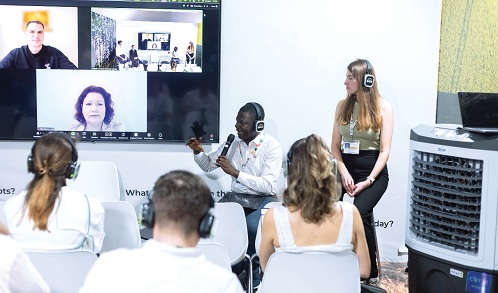
Jospong Group outlines blueprint for private sector in carbon markets
The Jospong Group of Companies (JGC) has urged Ghana's private sector to strategically position itself for a seamless transition from carbon market readiness to tangible climate action.
The General Manager of the Green Transition Office at JGC, Dr Glenn Kwabena Gyimah, said the time had come for private entities in the local space to leverage the country's Article Six framework, which seeks to mobilise finance for the nationally determined contributions (NDCs) to climate change, to drive both environmental and social impact.
Dr Gyimah made the call during a World Climate Foundation panel discussion on the sidelines of an ongoing climate summit (COP30) at Belem, in Brazil.
"Ghana's carbon market office and National Authorisation Framework transformed carbon markets from a policy discussion into a viable business opportunity," he said.
Dr Gyimah said since last year, the Jospong Group had made significant progress in harnessing the potential of the carbon market, with five key implementation milestones.
For instance, he said, the company had successfully integrated its project portfolios with Ghana's National Carbon Registry, making the composting, landfill gas recovery, and clean cooking initiatives among the first to be officially tracked in the national system.
Dr Gyimah said their approach went beyond mere carbon credit generation to charting a path for sustainability in providing development solutions.
Progressive models
The GM said Ghana had progressive emerging models that were shaping the country’s carbon market landscape.
"Our community benefit-sharing model ensures that carbon revenue is reinvested in local development, supporting schools, clean water, and reforestation initiatives," he said.
Dr Gyimah underscored the need for a forward-looking perspective and a robust carbon market regime that would ensure sustainability and improve lives.
"Our experience demonstrates that when government and business work in synchronisation, carbon markets become more than just transaction platforms; they evolve into powerful instruments for sustainable national development and green growth," he added.
Success
A senior sustainable officer at JGC, Dr Gloria Boamah Kusi, who spoke at the launch of a LONGi Climate Action White Paper, a side event, last Saturday, said an Integrated Recycling and Compost Plant (IRECOP) initiative by Jospong Group through its subsidiary, Zoomlion Ghana Limited, had not only helped to protect the environment, but also generated sustainable jobs.
"It has created over 1,000 green jobs, with more than 35 per cent of these roles filled by women.
It is simultaneously improving sanitation and living conditions for over 1.4 million residents across Ghana," she said.
Dr Kusi said the achievement by IRECOP was the outcome of a people-centred climate model.
"This is what we proudly call carbon inclusion, ensuring the benefits of climate finance reach those who need them most.
It is proof that a sustainable business model can be both profitable and equitable, where waste truly becomes wealth," she added.
