
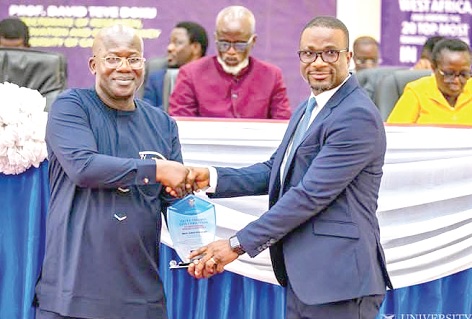
Let’s prioritise investment in research — WACCI Director
The Director of the West Africa Centre for Crop Improvement (WACCI), Prof. Eric Yirenkyi Danquah, has urged both the government and the private sector to invest more in research for an accelerated national transformation.
He emphasised that investment in research is not a luxury but a necessity in the development journey of any nation.
In that regard, he said, a country without researchers had no future.
Prof. Danquah, who is also the Chairman of the Governing Board of the Ghana National Research Fund, made the call during the second Research and Innovation Week and tenth Research Awards and Grants (RAG) of the Directorate of Research, Innovation and Consultancy (DRIC) of the University of Cape Coast (UCC).
It was on the theme, “National research funds for sustainable development: A strategic development agenda or a political rhetoric?”
Prof. Danquah lamented that many Ghanaian graduates travelled abroad for postgraduate studies and often refused to return, largely because of the lack of funding, infrastructure, and laboratories to support their research ambitions.
“Africa’s problem is not the absence of vision, but the lack of support. Public funding for research is not a luxury; it is a necessity. Our future development depends on research, which turns knowledge into national power,” he stressed.
National Research Fund
On the National Research Fund, he said, the long-anticipated fund would be officially launched on June 4, 2026, and urged policymakers to ensure that research findings informed national policies.
Prof. Danquah said the fund's board had already been constituted.
“For instance, if during the ‘Operation Feed Yourself’ programme, there had been consistent research to guide implementation, the policy would have stood the test of time,” he added and called on the Ghana Tertiary Education Commission (GTEC) to begin ranking universities in the country based on their individual departments.
He said such a system would make collaboration among researchers easier, as it would help identify which universities or departments excelled in particular fields for academic collaborations.
“If researchers know which school or department leads in a specific area, it becomes easier to collaborate and produce impactful results,” Prof. Danquah stated.
UCC strides
The Director of DRIC, Prof. David Teye Doku, underscored the crucial role of research and innovation in addressing modern global and national challenges.
He added that the UCC had made significant strides in research excellence, filing patent applications, securing copyright protections for software and evaluating new inventions for market potential.
He said the UCC’s consistent ranking as the number one university in Ghana and West Africa by the Times Higher Education World University Rankings and U.S. News and World Report was proof of the university’s growing global relevance.
He, however, called for improved infrastructure, reliable internet connectivity, and modern laboratories to maintain the institution’s reputation as a research-intensive university.
“In a world defined by uncertainty, climate shocks, pandemics, and economic disruptions, our greatest asset is our capacity to research and innovate,” he added.
For his part, the acting Vice-Chancellor of the UCC, Prof. Dennis Aheto, expressed appreciation to all faculty and researchers for their relentless commitment to excellence.
He recalled how the RAG ceremony, which began modestly in 2015 under former Vice-Chancellor, Prof. D.D. Kuupole had developed gradually and said it was remarkable that it had evolved into a major academic event, which now stood as a pillar of the university’s research culture.
Prof. Aheto said the occasion not only recognises outstanding research and innovation but also provides seed funding to help faculty test new ideas and attract external grants.
He, therefore, emphasised that impactful and transdisciplinary research was central to addressing global issues such as climate change, food insecurity and pandemics and reaffirmed the UCC’s commitment to the 2023–2027 Research Agenda, themed “Transdisciplinary Research and Innovation for Sustainable Development in a Changing World.”
He said such research directions were essential to finding sustainable solutions to contemporary challenges and were also aligned with the United Nations Sustainable Development Goals (SDGs) and Africa’s Agenda 2063.
The UCC acting Vice-Chancellor further called on the government to demonstrate leadership by fully establishing the National Research Fund, arguing that countries such as Nigeria, Kenya, and South Africa had shown that dedicated research funding drove national progress.
He also commended the UCC’s funding partners, industry collaborators and international bodies for their continued support and urged all stakeholders to remain committed to advancing innovation and discovery.
