
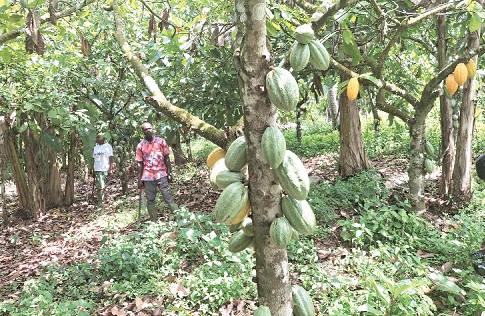
Protecting people and planet: Emissions reduction project leaves giant footprints
“I have about 10 hectares of cocoa farm, and for many years, my focus was only on cocoa production.
As you know, cocoa is a seasonal crop, so when it is off-season, farmers do not have anything to fall on for money.
“Based on the capacity building we got from the Ghana Cocoa Forest REDD+ programme (GCFRP), I decided to go into other areas of farming as alternative livelihood so that when cocoa is off-season, I can get money to take care of the family and support other people.
“Currently I have two hectares of pepper farm; two-and-a-half hectares of cabbage farm; two hectares of garden eggs farm; and, if you look at my farms now, I take over 200 people to work and pay them GH¢100 a day.”
These were the words of 45-year-old Collins Akonnor, as he narrated the transformation the GCFRP had brought to his life and the lives of other farmers.
The resident of Kyebi Odumase in the Abuakwa South Municipality in the Eastern Region doubles as the Atewa Hotspot Intervention Area (HIA) where 21,096 farmers are benefitting from the GCFRP.
At his two-hectare pepper farm at Wirenkyren Amanfrom in the Abuakwa South Municipality, a team of officers from the Global Landscape Forum (GLF), the United Nations REDD+ and the Forestry Commission on a field visit to the area visited on October 14 to appreciate the expanse of his agricultural project.
The field trip was meant to assess the impact of the GCFRP on the beneficiary farmers and how the programme had helped to ensure sustainable farming.
The implementation of the GCFRP started in 2019 against the backdrop of increasing depletion of the forests and the ripple effects on cocoa production, the country’s leading foreign exchange earner.
It was meant to address deforestation and forest degradation.
The programme is on three key objectives, namely reducing expansionist cocoa production activities in forest areas; cutting down emissions by about 40 per cent within the 20-year lifespan of the strategy (2016-2035); and improving the livelihoods of cocoa farmers.
The reward-based programme offered carbon credit payments from the Global Carbon Fund when the HIAs yield results.
Implementation
To ensure effective implementation of the programme, the National REDD+ Secretariat of the Forestry Commission and COCOBOD, with support from the chocolate industry and companies along the value chain, identified what is called hotspot intervention areas (HIA).
The six intervention areas are selected on the basis of the intensity of the drivers of deforestation and forest degradation, existing projects and interventions being implemented by private sector and state actors, adequate capacity and implementation structures at the field level.
Five years after the implementation of the GCFRP, there is ample evidence to show that the programme has made positive impact on farmers and communities in the country’s cocoa forest landscape.
Statistics from the Climate Change Unit of the Forestry Commission revealed that since the GCFRP was implemented in 2019, the country received $21.8 million in carbon payments from the World Bank for reducing emissions by 4,351,626 tonnes of carbon dioxide equivalent (tCO2e).
The statistics showed that in 2023, the country received $4.9 million for 972,465 tCO2e for the 2019 monitoring year, while $16.9 million was received in 2024 for 3,378,161 tCO2e covering the 2021 and 2022 monitoring years.
Additionally, the figures showed that there was an outstanding amount of $29 million payment covering benefits for carbon reduction from 2022 to 2024.
A further delve into the records revealed that more than $13.9 million of that amount was disbursed to 560,808 cocoa farmers across six hotspot intervention areas in the country’s cocoa forest landscape.
A breakdown of the figures showed that the Asunafo Asutifi HIA received in excess of $5 million; Juaboso-Bia received $3.6 million; while the Kakum HIA got $1.6 million.
Also, the Ahafo HIA had over $1.3 million; Sefwi Wiawso-Bibiani got $1.3 million; while Atewa received about $1.1 million. The statistics also showed that there was an outstanding amount of over $28.2 million to be paid by the World Bank for the 2022 to 2024 monitoring years.
Positive impacts
During the field trip to the Atewa HIA, it came to light that 21,099 farmers, comprising 12,407 male and 8,652 females were benefitting from the programme.
A visit to cocoa farms and alternative livelihood project sites in communities such as Kyebi-Potroase and Wirenkyren Amanfrom revealed that the GCFRP had made great impact in the lives of farmers and the residents in those areas.
Mr Akonnor said the carbon payment the Atewa HIA had received so far had been used for the implementation of some community projects and procurement of inputs for climate action.
He explained that 58 per cent of Atewa HIA’s share of the funds went into procurement of cutlasses, Wellington boots, motorised mixed blowers, tree seedlings to support farmers.
Mr Akonnor said the managers of the Atewa HIA had procured about 60,000 tree seedlings and shared to farmers in the area.
He said the remaining 39 per cent of the allocation the Atewa HIA received had been used for community projects such as construction of boreholes, health facilities, and other projects that were of necessity to the people.
“The funds have really benefitted farmers. Initially, our understanding about the environment was very low, so we engaged in bad farming practices that affected the forest.
But through this programme, they have built our capacity on climate change, how our activities affect the climate, and how we can do sustainable farming,” he added.
The benefits
Mr Akonnor explained that 39 per cent of the amount had also been used for community projects such as boreholes, community-based health planning services (CHPS) compounds and other projects that were of relevance to the communities.
Additionally, he said through the alternative livelihood component of the programme, the farmers had received training on sound agronomic practices and climate-resilient farming approaches that helped them to engage in sustainable farming.
“Previously, farmers were targeting large hectares of land to farm on, but end up getting paltry yields after destroying the forest.
After adhering to the best farming practices taught us by officers from the Forestry Commission and extension officers from COCOBOD, the story is different.
“We have been taught to take our farms as a business. After adapting to best agronomic practices, I get between eight to 12 bags of cocoa per hectare per season,” Mr Akonnor said.
At Kyebi-Potroase, 57-year-old Mary Bampo was full of excitement as she narrated the transformation the programme had brought to her cocoa farming business.
According to her, the GCFRP had breathed a new lease of life into her four-and-a-half-hectare cocoa farm that had produced poor yield over the decades.
“Before the REDD+ programme was introduced to us, I could barely make two bags of cocoa per hectare from my farm; but now, I harvest about 20 bags of cocoa,” she said.
Meanwhile, the over 700 residents of Akyem Asamama Zongo in the Akwaboso Electoral Area in the Atewa East Akim HIA no longer waste hours searching for potable water, thanks to the provision of a mechanised borehole by the World Bank under the GCFRP in July this year.
