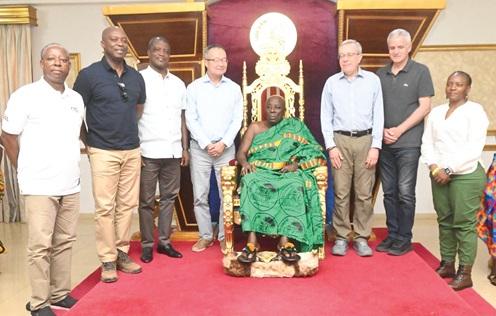
Let’s tackle extreme poverty causes - Okyenhene to World Bank, others
The Okyenhene, Osagyefuo Amoatia Ofori Panin, has urged the World Bank to support Ghana in tackling the root cause of poverty to make conversations around climate change more meaningful to the people.
He said conversations about sustainable development would not yield the needed results if the people, especially women, continued to face extreme poverty and hopelessness.
“In our part of the world, we are still battling poverty, battling illiteracy, different diseases, and it looks as if geographical location determines whether the people have access to a good life or not,” the Okyenhene added.
Addressing a delegation from the World Bank Group at the Ofori Panin Fie in Kyebi yesterday, the Okyenhene said the geography of birth should not determine whether a child had access to medical care, quality education or love.
Delegation
The delegation was led by the Vice-President of the World Bank Group in charge of Planet, Guangzhe Chan.
Other members of the team were the Regional Practice Division for the Planet Team in charge of Western and Central Africa, Chakib Janane, and the World Bank Country Director, Robert Takiercio.
They were in the country to assess the progress of implementation of a Red Class Strategy project funded by the Forest Carbon Partnership Project under the World Bank.
The team would also assess how funds had been used to support livelihood activities and climate-smart projects, especially for farmers in cocoa-growing communities.
The project, valued at $50 million, which was started in December 2019, is supposed to end in December 2027.
The facility is being used to fund six hotspot intervention areas (HIAs) in Ghana, for which $1million was supposed to have been invested in the Atiwa Forest Range.
Situation
Osagyefuo Ofori Panin said that Africa had become the “headquarters” of poverty as a result of how the West looted its natural resources, depriving the people of what they needed most to enhance their living standards.
“The Europeans came and looted us, and when we came to power, we also ignored our rural Ghana, which has made our communities very poor,” he said.
On the destruction of the Atiwa Forest, the Okyenhene said the forest had rare animal and plant species that could not be found anywhere else.
He said traditional authorities were no longer in control of the laws of the land, adding “we do not make the laws and we have no coercive force, and so even if our forest is being attacked, it is the Forestry Commission and the government that must try to curb it”.
“Our forebears understood this long before we got here.
While they respected the rule of law, they also understood the rule of nature that we need to live with other species, use them for our benefits and not to destroy them,” the Okyenhene said.
Natural asset
Mr Chan commended the Okyenhene for his sustained effort in environmental sustainability and for being a long-term collaborator of the World Bank.
He said forests, a reversible natural asset, were not only for the Okyeman communities and Ghana, but a global property.
“That is why we all have a responsibility to help support your efforts in preserving this natural capital and for the benefit of humankind, including communities you oversee.
“We really value this partnership and will, therefore, continue to support your effort in moving this agenda forward,” he added.