
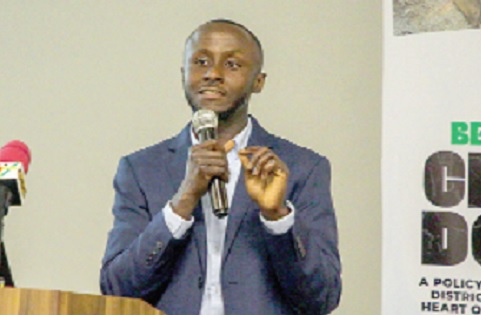
Make local assemblies centre of galamsey fight - 2 Environmental bodies urge govt
Some stakeholders in environmental protection have called on the government to place district assemblies at the centre of efforts to tackle illegal mining for more impactful and lasting results.
They argued that repeated crackdowns had not been effective because local institutions, especially district assemblies, were often overlooked and their roles underestimated in the fight against illegal mining.
The two environmental protection consulting firms, SysGlo Consulting and JPRS Consulting and the Centre for Climate Change and Sustainability Studies, at the University of Ghana, made the call at a policy dialogue in Accra.
They called on the government to move beyond crackdowns and adopt a governance-driven approach that integrated district assemblies into the core of mining regulation and oversight.
Dialogue
The dialogue was titled, 'Beyond the crackdown' and it brought together policymakers, district assembly officials, researchers and civil society actors involved in Ghana’s mining and environmental governance sectors.
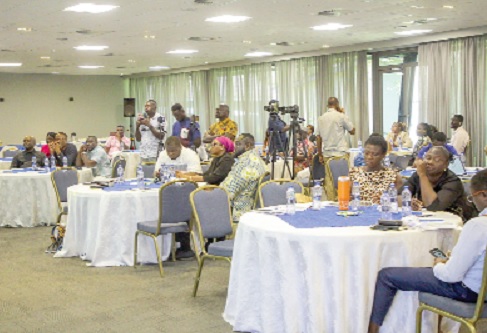
Participants in the event
Participants in the event agreed that illegal mining had evolved into a complex economic and social system that required coordinated institutional responses rather than isolated enforcement actions.
The dialogue also featured the launch of the District Assemblies Mining Tracker, a software designed to support local monitoring and accountability in mining communities.
The event referred to the experience of Atiwa East District as a case study, highlighting how district-led approaches could improve oversight and enforcement.
They indicated that the model would be refined and scaled up through engagement with national institutions to inform broader policy adoption.
Changing approach
An environmentalist and consultant at both SysGlo Consulting and JPRS Consulting, Dr John Boakye Danquah, stressed that national-level reforms had not translated into effective local governance structures.
He said research conducted in mining communities had revealed a disconnect between policy assumptions and realities on the ground.
“We have strengthened policy at the national level, but we have not fully built governance at the local level. If we continue to treat this as a problem of enforcement alone, we will continue to get the same results,” he said.
He then urged the government to provide district assemblies with the authority, resources and coordination mechanisms required to manage mining governance effectively at the local level.
Inclusion
Dr Danquah also wants the government to incorporate local voices into mining governance and decision-making processes.
He said engagement with miners, chiefs and district officials had revealed widespread exclusion and frustration.
"We have young people telling us: ‘We are not criminals, we are jobless.’
We have chiefs asking: ‘How can decisions about our land be made without us?” he asked.
Situation
The Director of the Centre for Climate Change and Sustainability Studies at the University of Ghana, Professor Yaw Agyeman Boafo, said the illegal mining challenge had created systemic risks that directly affected ecosystems and livelihoods across affected districts.
He pointed to widespread degradation of forests, pollution of rivers and loss of productive land as interconnected challenges.
He said damaged river systems threatened water availability while deforestation weakened carbon sinks and increased vulnerability to climate shocks.
Prof. Boafo added that research institutions would continue to support evidence-based discussions to guide practical and sustainable solutions.
Collaboration
For his part, the District Chief Executive (DCE) of Atiwa East, Ernest Owusu Ntim, called for stronger collaboration across institutions.
He pointed to progress within Atiwa East as evidence that local leadership, supported by community engagement, could deliver results.
