
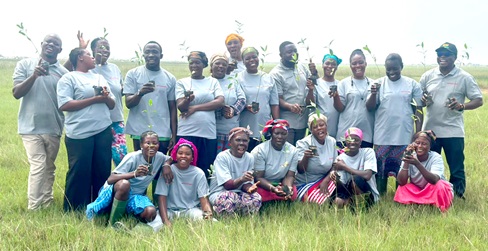
For generations, mangroves have served as a natural barrier protecting coastal communities in the Ada West District from flooding, tidal waves and shoreline erosion, while supporting livelihoods through fishing, crab harvesting and other ecosystem services.
However, years of unsustainable human activities, including excessive harvesting for fuelwood, pollution, salt mining and other forms of environmental degradation, have resulted in the depletion of these vital ecosystems.
Now, a major restoration effort is offering renewed hope to communities along the coast as residents, traditional authorities, government institutions and development partners collaborate to restore degraded mangrove ecosystems.
As Ghana joined the global community to commemorate World Mangrove Day 2026, ActionAid Ghana, in partnership with Habitat for Humanity International (HFHI), UN-Habitat and the University of Twente, launched a large-scale mangrove restoration initiative at Wokumagbe and Goi communities in the Ada West District.
The intervention is being implemented under the Improved Resilience of Coastal Communities in Côte d'Ivoire and Ghana (IRCC) Project, funded by the Adaptation Fund, to strengthen climate resilience among vulnerable coastal communities through ecosystem restoration and community-led adaptation.
The mangrove planting ceremony marked the beginning of the restoration of 38 hectares of degraded mangrove ecosystems in Wokumagbe and Goi through the planting of approximately 95,000 mangrove seedlings.
The activity formed part of this year’s commemoration of World Mangrove Day, observed on July 26 every year to raise awareness about the vital role mangroves play in protecting coastal communities and preserving ecosystems.
The Ada West intervention is part of a wider commitment by the IRCC Project to restore 410 hectares of degraded mangrove ecosystems in Ghana while promoting nature-based solutions that protect biodiversity, improve livelihoods and enhance the ability of coastal communities to withstand the impacts of climate change.
Data
According to the Forestry Commission of Ghana, Global Mangrove Watch, the IUCN Red List of Ecosystems Programme, and the Ramsar Information Service, Ghana has an estimated 13,000 to 14,000 hectares of mangrove forests, concentrated mainly within the Volta Delta, Keta Lagoon Complex, Songor Lagoon, Densu Delta, Muni Lagoon and Ankobra Estuary.
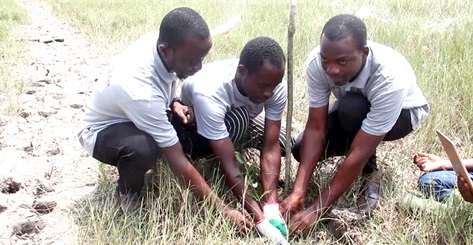
Nene Adjorkey Siaw VII, Chief of Wokumagbe, assisted by Justin Bayor, (2nd from left) Head of Programmes at ActionAid Ghana, and other officials ready to plant a seedling as part of the mangrove restoration efforts
However, these critical ecosystems continue to face increasing pressure from unsustainable harvesting for fuelwood and fish smoking, urban expansion, salt mining, pollution and climate change. As a result, more than 60 per cent of Ghana’s coastline remains vulnerable to coastal erosion and flooding, threatening biodiversity, livelihoods, food systems and the resilience of coastal communities.
The Volta Delta, where the IRCC Project is being implemented, is recognised as one of West Africa’s most significant coastal wetland ecosystems, supporting thousands of people through fishing, farming and salt production. Protecting these ecosystems is, therefore, essential for advancing climate justice, environmental sustainability and resilient livelihoods.
Intervention
The Chief of Wokumagbe, Nene Adjorkey Siaw VII, welcomed the initiative, describing it as a timely intervention for a community that had suffered from recurring floods, tidal waves and limited economic opportunities.
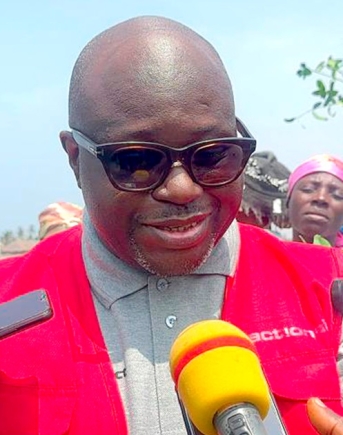
Justin Bayor, Head of Programmes, Campaigns and Innovation, Action Aid Ghana
He expressed appreciation to ActionAid Ghana and its partners for responding to the needs of the community and supporting efforts to protect the environment.
Nene Siaw VII said the restoration project had the potential to create employment opportunities for young people while improving livelihoods in the community.
“We are hoping that this project will bring opportunities so that the youth will get employment and receive some support to improve their lives,” he added.
Nene Siaw VII also acknowledged that protecting the restored mangroves would require commitment from residents, explaining that a lack of awareness had contributed to the destruction of the ecosystem in the past.
“Some people destroy or cut mangroves for firewood because they do not know their benefits.
But now that education is being provided, I believe community members will do their best to protect them so they can grow and benefit the entire community,” he said.
Nature-based solutions
The Head of Programmes at ActionAid Ghana, Justin Bayor, stressed that mangroves were among the most effective nature-based solutions for addressing climate change challenges.
He said the project was not only focused on planting trees but also on protecting communities, restoring biodiversity and creating sustainable livelihood opportunities.
“Mangroves matter, and therefore, we should try as much as possible to protect them,” he said.
Mr Bayor urged community members to safeguard the planted seedlings from activities that could undermine the restoration efforts, including the movement of cattle through newly planted areas.
He assured residents that ActionAid Ghana, together with the Forestry Commission and other partners, would continue monitoring the project and providing education on the importance of mangrove conservation.
The Ada Forestry Commission also pledged technical support to ensure the survival and growth of the seedlings.
The Site Manager, Ernest Apenkwa, said the area once had extensive mangrove vegetation, but human activities had led to their disappearance.
He explained that the commission would provide technical guidance, monitoring and support to community groups involved in the restoration process.
“We will give advice to the groups we have formed and provide regular monitoring to ensure that the project achieves its objectives. It will also enhance biodiversity in our ecosystem,” he said.
The Presiding Member of the Ada West District Assembly, Lawrence Katey Nunekpeku, described the initiative as an important step towards restoring the district’s wetlands and protecting coastal communities.
He noted that the decline of mangroves had affected fishing, crab harvesting and other traditional livelihoods that depended on the coastal ecosystem.
He appealed to the project partners to extend the intervention to other coastal communities around the Songor Lagoon, noting that environmental challenges affected the entire coastal zone.
“We are grateful that you have come to help us restore the mangroves.
We want this intervention extended to other communities because migratory birds and other species do not live only around Wokumagbe,” he said.
For Liticia Charwetey, a member of the Women Mangroves Restoration Group in Wokumagbe, the project represents both environmental recovery and economic opportunity.
She thanked ActionAid Ghana for introducing the initiative and said the restoration programme would provide jobs for young people while helping residents understand the importance of protecting mangroves.
“I did not know mangroves help to reduce flooding, but now I have learnt that when they are planted along riversides, they support fish production and benefit the community,” she said.
Background
The IRCC Project builds on earlier mangrove restoration efforts in the Anloga District, where thousands of seedlings have already been planted.
With more than 60 per cent of Ghana’s coastline vulnerable to erosion and flooding, stakeholders believe restoring mangroves is essential to protecting communities, conserving biodiversity and securing livelihoods.
For Wokumagbe and Goi, the seedlings planted today represent more than trees—they symbolise hope, resilience and a renewed commitment to safeguarding Ghana’s fragile coastal ecosystems for generations to come.
Writer's email:
