
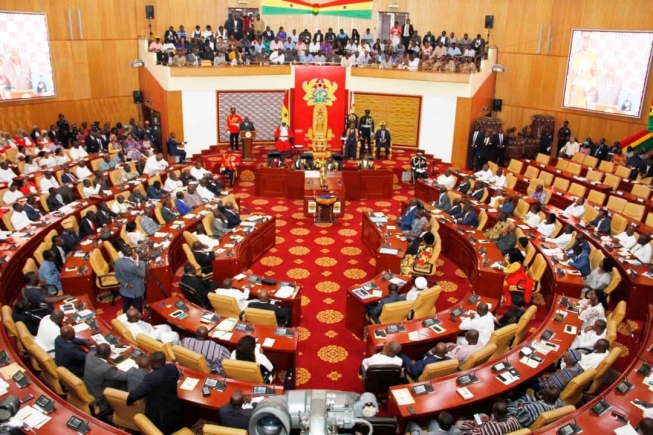
Two Members of Parliament (MPs) last Wednesday expressed differing opinions on the Supreme Court's ruling declaring the delegate system used by political parties to elect their presidential and parliamentary candidates unconstitutional.
They are the National Democratic Congress (NDC) MP for Banda, Ahmed Ibrahim, who is also the Minister of Local Government, Chieftaincy, and Religious Affairs, and the New Patriotic Party (NPP) MP for Kwadaso, Professor Kingsley Nyarko.
While Prof. Nyarko sided with the ruling and described the apex court’s decision as a step in the right direction as it would ensure inclusivity, Mr Ibrahim said although the ruling was constitutionally right, it was socially discriminatory as minority tribes would not be represented in a country where ethnicity formed part of Ghana’s social structures.
Prof Nyarko
Prof Nyarko said the ruling would allow all registered members of a political party to have a say as to who would represented them in presidential and parliamentary elections.
He described the apex court’s ruling as a “step in the right direction”.
He said the ruling would allow all duly registered members who align with a political party to participate in the party's internal elections.
Raising concerns about how such a ruling would be implemented, Prof. Nyarko noted that, due to monetisation within the political space, the delegate system was not a good intervention in “electing our leaders”.
“I always agree that whether it is the Electoral College or expanding it to include as many people, I think until there is punitive legislation to deal with monetisation or vote buying, it will be difficult for the ruling to achieve the intended purpose,” he said.
Minority exclusion
On his part, Mr Ibrahim considered the ruling a major disadvantage to minority tribes in certain districts.
He explained that the ruling would only allow dominant tribes to elect their representatives to Parliament, with minority candidates being “eliminated”.
“If you have a constituency where three-quarters of the tribes are from different minority groups, nobody from that constituency will be elected into this House,” he said.
He said that when minority groups presented candidates and they were voted against, they would believe that there was no way a person from their tribe could emerge victorious, thereby tempting them to stand as independent candidates.
“When people of integrity come from minority tribes, they are sometimes bullied by the majority.
As a result, the majority may present any candidate who can win, while a person of integrity from a minority tribe loses.”
“This is because democracy is the rule of the majority,” he said, saying that such development could see majority tribes always dominating elections, sidelining candidates from minority tribes.”
Mr Ibrahim agreed that the delegate system was cost-effective, manageable and elected candidates who could have a good record and be voted for.
“Apart from helping to manage the democratic system, universal adult suffrage can lead to unqualified candidates being elected.
