
The Next Steps High-Level Consultative Summit on Reparatory Justice has adopted a coordinated global strategic framework with 18 strategic pillars to guide reparatory justice for the transatlantic slave trade, colonialism and related historical injustices.
The framework, approved in Accra last Friday at the close of the three-day summit, outlined concrete actions under 18 priority areas, with emphasis on truth-telling, legal reform, compensation, restitution, education and systemic change.
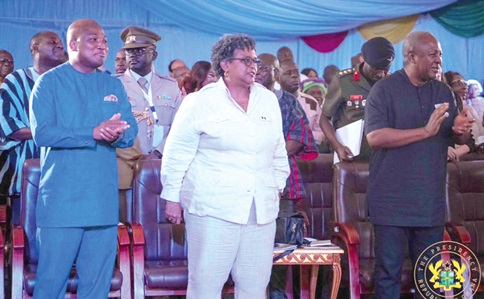
The outcome document containing the 18-pillar framework was presented to President John Dramani Mahama, the convener of the summit, by the Minister of Foreign Affairs, Samuel Okudzeto Ablakwa, at the observance of Juneteenth last Saturday.
Juneteenth marks the day enslaved African Americans in Texas finally learnt they were free, more than two years after slavery had legally ended.
The document would serve as a coordinated roadmap for Africa, the Caribbean, Latin America and Peoples of African Descent to pursue reparatory justice collectively ahead of the 82nd UN General Assembly.
The summit was convened following UN Resolution A/RES/80/250 recognising Slavery and Transatlantic Slave Trade as the worst of crimes against humanity, adopted on March 25, this year.
Core demands
The framework demanded “acknowledgement and apology”. It calls on states and non-state institutions yet to do so to issue acknowledgement of their role in the trafficking of enslaved Africans and to offer full, formal and unconditional apologies as a foundational step towards reconciliation, trust-building and reparatory justice.
It insists apologies must be “accompanied by guarantees of non-repetition, including the repeal of legal and ecclesiastical codes”.
Under “Law and Justice”, delegates committed to strengthening legal pathways, including international and domestic mechanisms, and urgent reform of criminal justice systems to address the challenge of systemic racism against People of African Descent.
It also called for “Compensatory Reparations”, reaffirmed the demand for “fair and adequate compensation for the people of Africa and People of African Descent”, and to develop modalities for determining compensation.
The framework resolved to accelerate the return of cultural property, human remains, archives and heritage to countries of origin, and to strengthen coordination at the United Nations Educational, Scientific and Cultural Organisation (UNESCO).
It reaffirmed the 2023 Common African Position on the Restitution of Heritage Resources.
It also urged “decolonisation” of remaining European and American colonies in line with the UN Decade for the Eradication of Colonialism, and “global governance reforms,” including reforming the UN Security Council and international financial institutions, for equitable representation.
On “economic justice”, the framework rejected the current unbalanced and unequal global economic and development architecture, called for “debt relief, restructuring and cancellation” where necessary, reforms to sovereign credit ratings, and restitution for countries in special situations such as Haiti.
It commits to dialogue on a “Global Reparations Fund” anchored on transparency and inclusion.
People-centred pillars
Other pillars address “corporate accountability”, “technology innovation and capacity building”, “public health and well-being”, including recognition of “medical apartheid”; “gender justice” with gender-responsive reparations, and “climate justice” linked to the International Court of Justice advisory opinion on climate obligations.
The framework also mandates “spiritual and psychological rehabilitation”, “education and cultural renewal”, “truth, documentation and public memory”, including preservation of African forts and castles, and “diaspora engagement, citizenship and right of return”, based on the 1993 Abuja Proclamation.
Commendation, unity
Speaking at the event at the Osu Castle last Saturday, President Mahama thanked delegates for the outcome documents produced, saying it created a platform for how parties forged ahead together in unity to achieve the justice that was denied their forebears.
The President said it was the first time Africa and its diaspora are “beginning to speak with one voice” on reparatory justice, urging unity to secure justice denied to forebears.
The President stressed the need for unity as the work went beyond restitution and reparations, underscoring that the world was rigged against the descendants of slaves and the victims of slavery.
“The inequities of the slave trade remain.
The demography that slavery affected is still the poorest part of this world.
Our work goes beyond reparations.
It goes beyond the return of artefacts.
“It goes into advocacy for creating a more equal world.
To a world that offers opportunity to everyone.
And to a world that is fair and just,” President Mahama stressed.
Visa-waiver
The President said the nation was open to the diaspora, stressing that people of African descent could visit the country whenever they wanted.
“We have passed an Act that allows people of African descent to seek abode in Ghana.
If you want to come home, back to the motherland, Ghana is one of the countries that has a law that allows you to come and stay in Ghana,” he said.
President Mahama stressed the introduction of a visa-free regime for all Africans, with the Ministry of Foreign Affairs working to extend the same to Caribbean Community (CARICOM) countries and pointed to existing visa waivers with many CARICOM states.
