
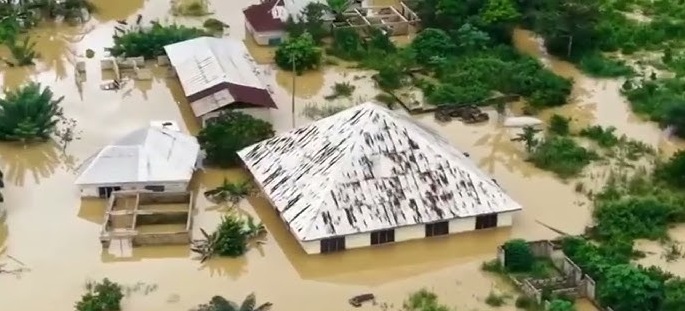
Hours of rainfall at the weekend left parts of the Western and Central regions flooded, with Samreboi and Cape Coast turned into massive ponds populated by buildings and trees.
The incidents marked new limits of flooding in the two areas, as the phenomenon extended into previously less-prone areas in the wave sweeping across the country this year.
Three persons died in the Cape Coast incident, with three women injured.
They are a 20-month-old child and two occupants trapped under a collapsed structure at Gyagyano, behind Yoghurt Fie on Idan Fourth Alley, who died yesterday following the heavy rains.
They have been identified as Anastasia Abakah, 12, and Adwoa Baduwa, 40.
Two died at Samreboi in flood-related incidents.
Samreboi
In the Western Region, the downpour in Wassa Amenfi and adjoining districts caused havoc in Samreboi after two large rivers and watercourses overflowed their banks in a community known for years of uncontrolled illegal mining, commonly called galamsey.
The devastating floods submerged a large part of Samreboi as the Samre and Tano rivers burst their banks, sending high currents of floodwaters into homes and farmlands, cutting access roads and grounding transportation services, and forcing residents into rushed evacuation.
Illegal mining activities in the forest reserves and water bodies in and around Samreboi blocked parts of the two rivers, making it difficult for floodwaters to flow freely into the ocean.
An 18-month-old child died when the parents focused energy into salvaging their property as the floodwaters gushed forward, only to find that the sick child’s condition had grown worse when they returned to care for the child.
An epileptic, who was also walking through the water to safety, had a sudden crisis, and fell into the water, leading to his death.
The flooding displaced hundreds of households, collapsed more than 24 homes, destroyed farms, and disrupted commercial activities.
Many displaced residents are now taking shelter in classrooms at the Samreboi Catholic Junior High School, Aboifie MA, and the Samatex School Complex, among other places on higher ground.
Community members said the rain was not heavy, but the downpour in other parts of adjoining districts and regions caused rivers to swell rapidly to unprecedented levels in the wake of galamsey.
Some residents who experienced the incident explained that after a few hours of rainfall, they realised that the water levels at the banks began to rise, and after some hours, water began to enter the community and people’s rooms.
They blamed the flooding on the destruction of the environment due to illegal mining in the forest reserve, saying it had diverted the courses of the water tributaries.
NADMO intervention
The National Disaster Management Organisation (NADMO) at the regional and district levels described the situation as critical and vowed to ensure that they did everything to ensure the safety of the people.
The Western Regional Minister, Joe Nelson, who had a marshalled team to assess the situation, assured residents that the Regional Coordinating Council and the regional directorate, through its district team, would not abandon the people.
He said, so far, some relief items, such as foodstuffs, safe water and mattresses, among others, had been dispatched as they worked to contain the situation, with immense support from Samatex.
The Regional NADMO Director, Daniel Darlington Atitso, said the team on the ground was receiving support from the Member of Parliament for the area, the District Chief Executive, corporate entities in the area and the Regional Minister to contain the situation.
Security personnel were deployed to the Samreboi area to rescue affected people and property.
Extent of damage
Mr Atitso said the main focus was to ensure the safety of the affected residents as they waited for the water level to recede.
“So far, we are encouraging affected people to stay away from the affected areas, and those who are closer to flooded zones should, as a matter of urgency, start moving to higher grounds,” he said.
He commended Samartex Timber and Plywood Company for helping affected people with health care, hot meals, and safety information to enable them to stay safe.
Samatex
The General Manager of Samatex, Ransford Quainoo, attributed the flooding to years of illegal mining and related activities that had blocked the flow of the Tano River.
He said information indicated that at the peak of the illegal mining activities before the clampdown, the main river course was blocked to enable the miners to use their excavators to cross the river to the other side.
The blockage, he said, had created a dam, and, therefore, after the prolonged rain in the adjoining districts and regions, water was not able to flow through the normal
“As a company, we have a pump on the river that pumps water to cool our turbine to generate our lights, but everything has submerged now due to the increasing levels of the river.
For now, we only hope it stops raining upstream and the level recedes,” he said.
Cape Coast
The torrential rain that battered Cape Coast last Friday left several parts of the metropolis flooded, disrupting transportation, business operations and academic activities, while raising fresh concerns about the city's recurring flood challenges.inundating roads, homes and public spaces across the metropolis, making movement difficult for both motorists and pedestrians.
Among the hardest-hit areas were the Electricity Company of Ghana (ECG) enclave, the Cape Coast Sports Stadium area, sections of the road leading to the Cape Coast Teaching Hospital (CTH), the Ghana National College vicinity, and the University of Cape Coast (UCC).
Floodwaters submerged portions of major roads, causing traffic congestion and forcing some drivers to seek alternative routes while others struggled to navigate the waterlogged streets.
At UCC, sections of the campus, including the area behind the Sandwich Lecture Block, Science Roundabout, Zenith Bank area, Ayensu, and parts of Sasakawa, were affected by the flooding.
The situation prompted university authorities to issue a safety advisory urging students and staff to remain indoors where possible and avoid unnecessary movement until conditions improved.
The advisory followed concerns over the rising floodwaters and the dangers associated with crossing submerged roads and walkways.
Residents and commuters described the situation as one of the most challenging rainstorms experienced in recent months, with some pedestrians wading through floodwaters to access their workplaces, schools and business centres.
Along the Cape Coast Teaching Hospital stretch, motorists experienced significant delays as portions of the road became submerged, slowing traffic and creating long queues during peak hours.
Businesses
Business activities were not spared. Some traders delayed opening their shops while others reported reduced patronage as customers struggled to move around the city.
Residents attributed the persistent flooding to choked drains, poor drainage infrastructure and uncontrolled development in some parts of the metropolis.
Many expressed fears that with the rainy season yet to peak, more severe flooding could occur if urgent interventions were not undertaken.
