
Panellists call for enforcement of mining laws
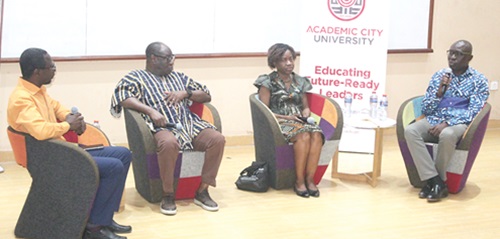
Panellists at a symposium on illegal mining have called for better enforcement of laws and advocacy to eradicate the menace from the country.
They said that it was the constitutional mandate of every citizen to protect the environment, adding that the government must be proactive in addressing illegal mining.
The panellists further lamented the alleged lack of political will and efforts by security agencies to stop the activities of illegal mining across the country, as well as protect persons such as journalists who attempt to expose the issues.
The speakers were the General-Secretary of the Ghana Journalists Association, Kofi Yeboah; a legal practitioner, Awola Serwaa, and the Head of Mining at the Environmental Protection Agency (EPA), Michael Ali.
The event was organised by the Academic City University, Accra, on the theme: “Unpacking galamsey: Uncovering ‘Treasures’ in responsible mining.”
It was aimed at deepening the national conversation on illegal mining and exploring practical solutions to address its impact on communities and the environment.
In attendance were academics, civil society actors, journalists and policymakers, who shared experiences, proposed ideas and designed actionable strategies.
Speakers
Mr Yeboah highlighted the dangers journalists went through to bring out stories on galamsey, and called for the establishment of a dedicated fund for journalists to be well resourced and protected in the line of duty.
Ms Serwaa also stressed the importance of being well informed about issues concerning illegal mining to push the government to address the menace.
She was optimistic that galamsey could be eradicated if there was the political will to do so.
For his part, Mr Ali said that the EPA was doing its best to ensure the environment was protected. He, however, emphasised the need to protect their officers, particularly forest guards.
Restoration projects
In a speech read on her behalf, the Chief Executive Officer of the EPA, Professor Nana Ama Klutse, said two major restoration projects were underway in the northern and southern parts of the country under the Ghana Large and Small-Scale Mining Restoration Initiative to rehabilitate lands affected by illegal mining, and also promote biodiversity recovery.
She entreated traditional leaders to protect their lands, while urging the media to expose corrupt networks, and the youth to resist recruitment into illegal mining activities.
“Let us mine not just the gold beneath our soil, but the greatness within our values.
Our rivers and forests must be preserved for future generations,” Prof. Klutse added.
Research
The Vice-President, Academic Affairs, at Academic City University, Dr Sena Agbodjah, said galamsey was a complex phenomenon which needed a multi-stakeholder approach to solve.
She said that because community leaders were powerless, people came with concessions, and they had to agree.
Dr Agbodjah said academia must play a vital role in developing solutions and interventions to restore water bodies and destroyed lands through research, centralised data systems and surveillance technologies such as drones.
She also challenged students of the university to think about ways to help alleviate some of the issues in the biomedical space.
The Vice-President, Institutional Advancement, of the university, Dr Lucy Agyapong, reiterated that illegal mining was a threat to health and safety, destroyed water bodies and farmlands, and undermined law and order.
“We found out that galamsey is a reflection of deeper issues, poverty, weak governance, poor enforcement, lack of accountability and the abuse of power,” she said.
