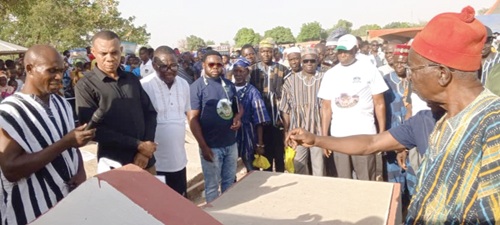
Preserving cultural heritage: Residents hold durbar in honour of deceased crocodile
In our Ghanaian society, it is an accepted practice for people to give their departed relatives befitting burials, sometimes with names inscribed on their graves as a mark of honour and remembrance.
In Paga, however, such reverence is not reserved for humans alone; crocodiles, regarded as sacred members of the community, are accorded the same dignity in death, as they are seen not merely as wildlife but as ancestral beings.
Tradition holds that the death of a crocodile often coincides with the passing of a prominent community member, while unusual crocodile cries are believed to signal impending loss or danger.
This practice goes beyond symbolism and is deeply rooted in the people's culture. For generations, the people of Paga have believed that crocodiles share a mystical bond with their ancestors.
They are seen not as ordinary reptiles, but as embodiments of ancestral spirits and silent guardians who watch over the community.
Oral tradition holds that this relationship dates back centuries and is grounded in coexistence, protection and mutual respect.
The burial rites reflect this belief system. When a crocodile dies, it is mourned like a human being, retrieved, laid in state, and buried in a designated cemetery, accompanied by rituals to honour its life and role in the community.
In some cases, graves are marked with inscribed names, ensuring they are remembered as part of the people’s lineage.
Beyond this cultural link, the crocodiles also hold economic value.
They have become a major tourist attraction, drawing visitors from across Ghana and beyond, while providing livelihoods through guiding, storytelling and hospitality.
This blend of spirituality, culture and livelihood makes their burial not just a ritual, but a duty that preserves identity and tradition.
Durbar
It was against this rich cultural backdrop that the people of Paga, on Saturday, March 21, 2026, gathered for a solemn durbar at Zenga to honour the memory of Yuu-Nyenga, the revered crocodile first discovered by the Zenga community in 1963 and believed to have lived for over a century before its demise on December 24, 2025.
The ceremony, organised by the Zenga Youth Association with support from Kacstone Records, drew traditional authorities, tourism officials, youth groups and residents, all united in celebrating a creature that symbolised peace, unity and livelihood for decades.
The burial of this legendary crocodile brings to six the number of crocodiles given befitting burials at the crocodile cemetery located at the entrance of the Paga-Zenga crocodile pond, which has been walled to preserve it for generations.
Heritage and tourism
Yuu Nyenga, the crocodile's name, literally means “horn on the head” because of its distinctive physical feature.
It was widely known for its extraordinary friendliness. Tourists could sit, lie and even stand on it, a rare phenomenon that has made Paga famous globally.
Speaking at the event, the Assembly Member for the Zenga Electoral Area, Aloah Adoa Muniru, recounted that the crocodile pond was originally constructed in 1960 by the Agricultural Department as a water source for both humans and animals.
He explained that the crocodiles, believed to have a spiritual connection to the community's ancestors, later inhabited the pond and became central to the people's identity.
“The legendary crocodile we are celebrating today was among the first to be trained. It became a major attraction and contributed significantly to tourism and the local economy,” he said.
Beyond tourism, the crocodiles hold deep cultural and spiritual significance for the people of Paga. According to tradition, crocodiles are regarded as sacred and are treated with reverence, even in death.
“We do not harm them or eat them. When they die, we bury them just like human beings because they are part of us,” he said.
Yuu Nyenga, which died on December 24, 2025, was said to have been attacked prior to its death, a development that has heightened calls for stronger protection of the reptiles.
Calls for desilting of pond
Speakers at the durbar called for urgent action to preserve the Paga crocodile pond, which hosts over 200 crocodiles but faces threats from low water levels, encroachment and poor maintenance.
The Chairman of the Zenga Youth Association, Emmanuel Kuseh, described Yuu Nyenga as a globally recognised symbol and called for dredging and fencing of the pond to avoid encroachment.
The Upper East Regional Director of the Ghana Tourism Authority, Joseph Appiagyei, described the site as a key tourism asset and urged tree planting and rehabilitation efforts to protect it.
The Public Relations Officer of the Paga Youth Movement, Desmond Abire Ayambire, called for accountability in the use of revenue from the facility and reinvestment into its upkeep, warning of growing competition and potential security risks.
In a statement on behalf of the Managing Director of Kacstone Records, Wenowome Duriyem Aborah, the company reaffirmed its commitment to cultural preservation and highlighted the crocodiles’ role in tourism and job creation.
A Divisional Chief for the Kazigo community, Pe Parekuli Aluah, stated that the future of the pond depended on its maintenance and urged stakeholders to commit to its desilting.