
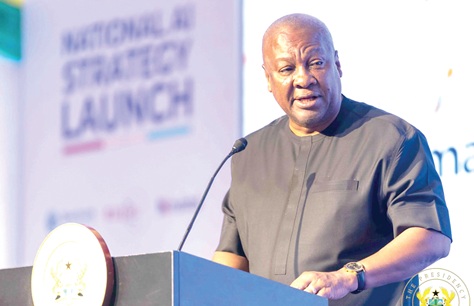
President unveils $270m National AI Strategy - $250m computing centre, $20m implementation fund earmarked to create Africa's AI Hub
President John Dramani Mahama has unveiled the National Artificial Intelligence (AI) Strategy, a bold $270-million investment, to transform the country into West Africa’s leading hub for AI innovation.
The strategy is aimed at using AI to drive national progress and sustainable growth in all sectors.
Launching the strategy in Accra yesterday, the President declared it a defining milestone in the country’s march towards a digitally driven economy, stressing that the nation must move beyond merely consuming foreign technologies to actively shaping their development.
“This is a significant milestone in our national journey towards a digitally empowered, innovation-driven and globally competitive Ghana,” President Mahama said.
“It is also a statement of intent that Ghana will not be just a passive consumer of technologies shaping the future but that we are going to be an active participant in designing, governing and deploying them for our national transformation,” he added.
$250m for computing centre
At the heart of the strategy is the establishment of a $250-million AI computing centre, a national facility the President described as the foundation for research, innovation and enterprise development.
Additionally, the country has earmarked $20 million for short-to-medium-term implementation of the strategy.
“Infrastructure is the foundation upon which innovation rests,” President Mahama said, adding, “These investments are bold but necessary”.
The President said ministers and senior officials had undergone a national AI boot camp, with AI focal persons designated within ministries to drive adoption across public administration.
Glimpse into the future
The atmosphere at the Labadi Beach Hotel, where the event was held, was electric, a blend of solemn statecraft and futuristic wonder.
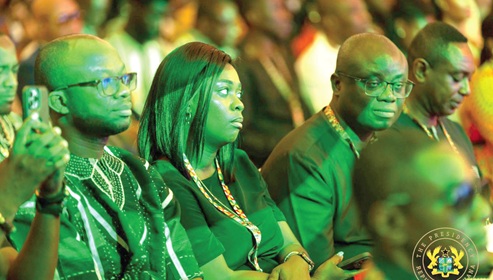
A section of participants in the launch
Seated in the front row, just a few paces from President Mahama, a sleek white AI-driven robot clad in kente fabric waited patiently for its cue.
When the moment came, it glided forward with quiet precision to deliver the first copy of the freshly unveiled strategy document, clutched in its mechanical grip, directly to the President.
The room erupted in applause and appreciative laughter, a spontaneous recognition that Ghana is on its way to achieving a major technological milestone.
New institutions
The Minister of Communications, Digital Technology and Innovations, Samuel Nartey George, in an interactive presentation, introduced the gathering to
“Aku”, an interactive AI assistant built to demonstrate how machine intelligence could be deployed across health care, agriculture, education and finance.
When asked questions, Aku answered in various languages, ranging from English, Ga, Twi, Dagbani, Ewe and Gonja, and walked the audience through real-time diagnostic support for a rural clinic, the financial system, and then switched seamlessly to touch on how farmers and fishermen could be supported for increased productivity.
The occasion drew a cross-section of national life that underscored the all-of-society approach the strategy demands.
Among the dignitaries were the Chief Justice, Justice Paul Baffoe-Bonnie; Senior Presidential Advisor on Governance, Dr Valarie Sawyer; ministers of state, and members of the private sector, who followed every presentation with keen interest.
Also present were members of the Nungua Traditional Council, their presence a powerful signal that Ghana’s AI journey will not be the preserve of tech hubs in Accra alone, but will also seek the partnership of traditional authority and the very fabric of Ghanaian society.
The Minister of Communication, Digital Technology and Innovations underscored the need for collaboration across government, academia, industry and civil society groups.
Mr George stated that AI was already transforming health care, agriculture, education and finance.
“I trust that the judiciary will guide our ethical and legal application of artificial intelligence.
Ghana stands capable and ready of leading and becoming Africa’s AI hub,” he said.
Mr George, however, stressed that the country’s determination to use the technology must be responsible — within ethics.
The Head of Grants and Research at the Kwame Nkrumah University of Science and Technology (KNUST), Prof. Jerry John Kponyo, who was part of the strategy’s development, disclosed that an independent Responsible AI Authority would be established within the first year, along with a national AI Office under the Ministry of Communication, Digital Technology and Innovations.
A National AI Fund is also proposed to sustain long-term financing for research and innovation.
Caution
For his part, the Speaker of Parliament, Alban Sumana Kingsford Bagbin, who chaired the occasion, cautioned that poorly governed AI could deepen inequality, weaken social trust and marginalise the vulnerable.
“If left unchecked or poorly governed, it can deepen inequality, weaken social trust, threaten privacy, and marginalise the most vulnerable among us,” Mr Bagbin said.
The Speaker stressed that the strategy must serve as a social contract, aligning technological progress with human development.
