
Don’t call African languages vernacular: It's derogatory — UG Vice-Chancellor
The Vice-Chancellor (V-C) of the University of Ghana, Prof. Nana Aba Appiah Amfo, says it is derogatory remarks and an affront to African culture to label African languages or local dialects as vernacular.
She said the term was not only discouraging but actively tarnishing local dialects as recognisable means of communication and recognition.
The first female Vice-Chancellor of the university said the situation was made worse through an enforced declaration to discipline both language and identity, especially in schools where such languages were not permissible.
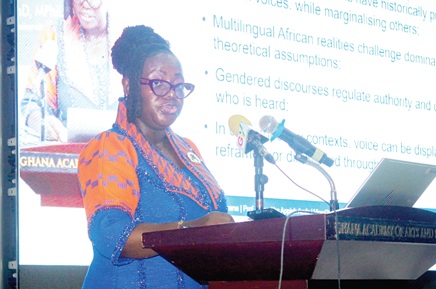
Prof. Appiah Amfo was delivering her inaugural lecture as a newly elected and inducted member of the Ghana Academy of Arts and Sciences (GAAS) in Accra last Thursday before one of the largest audiences the academy has ever witnessed.
Indeed, it was an assembly of people from all walks of life, including academia and students, with the distinguished presence of some past presidents of the academy.
They included political and social giants such as the Minister of Education, Haruna Iddrissu; former V-C of the University of Ghana, Prof. Ernest Ayeetey; renowned lawyer and Paramount Chief of Asokore Mampong, Prof. S. K. B Asante; a former Attorney-General and President John Dramani Mahama's personal Legal Advisor, Marrietta Agyeiwaa Brew; academic, author and human rights activist, Esi Sutherland-Addy; Director-General of the Ghana Tertiary Education Commission (GTEC), Prof. Ahmed Jinapor; acting Director of Legal Education at the Ghana School of Law, Prof. Raymond A. Atuguba; acting Chief Executive Officer of the Ghana Shippers’ Authority and a former lecturer at the University of Ghana’s Political Science Department, Prof. Ransford Gyampo.
Marginalisation
Speaking on the topic: "Reclaiming voice in the global order: Language, gender and the African academy," the professor of Linguistics said knowledge creation tended to be viewed through an Eurocentric lens in which Africa's ways of knowing were either marginalised or rendered "indiscipline".

Prof. Nana Aba Appiah Amfo (middle), Vice-Chancellor, UG, with some SHS students.
She said the act reflected a deeper structure of authority in which knowledge produced by an external observer was accorded pure legitimacy, while subsequent work by indigenous scholars often struggled for recognition.
She, however, posited that authority was not only about knowledge, but rather about who produced that knowledge.
Regrettably, the V-C said, research that aligned with the established Western paradigm was more readily accepted, while works branded in African realities often faced barriers.
"This dynamic is not only structural but deeply embedded in the everyday practice of academic knowledge production," she stressed.
Prof. Amfo said reflection on the politics of publishing suggested that what counted as legitimate knowledge was often determined not only by what was said, but by who said it, where it was published and whose work was cited.
In the frank presentation that drew applause repeatedly, the accomplished scholar of international repute said Africa could not afford to remain primarily a subject of other people's theories.
Highlighting the dynamics of the use of language, Prof. Amfo said the meaning of language did not reside in words alone but was constructed in context, shaped by relationships, assumptions and intentions.
She said what mattered was not what was said but who said it, to whom, and from what conditions.
"Language is rarely transparent. In Ghana, when a senior public figure says we are looking into the matter, this may signal reassurance or deflection, delay or be seen as a closure.
"This appears straightforward, but their meaning is negotiated within a shared understanding of political communication," she said.
Prof. Amfo said that while political communication, for instance, had become such a contested space, it had given thriving jobs to party communicators.
The V-C said statements that appeared clear on the surface were often followed with layers of explanation, re-interpretation and reframing.
"Sometimes to clarify, sometimes to recalibrate the meaning, and sometimes to shift public understanding altogether," she explained.
Prof. Amfo, who was inducted into the academy in 2021 but had to wait to deliver her inaugural lecture this year, said at times, the distance between what was said and what was communicated could be remarkably wide even in everyday discourse.
Gender
On the issue of gender, the V-C spoke passionately, alluding to the fact that to step into a male-coded space was to invite failure, embarrassment or even sanction.
She said a woman who rose beyond an expected limit invited a smaller reward, and sometimes with boundaries of possibilities.
"The ambition of a woman is seen as a transgression, equality as risk, and aspiration as something to be disciplined.
"These patterns are not relics of a distant past.
They persist, sometimes covertly,” she added.
The V-C said in the Ghanaian public and media space, some commentaries questioned the legitimacy of accomplished women or reduced them in ways that would not be applied to their male counterparts.
"We see how women in public life are evaluated. Women are not assessed with competence alone, but on appearances or perceived propriety.
"Confident women may be described as ‘too known’ or difficult," she asserted.
