
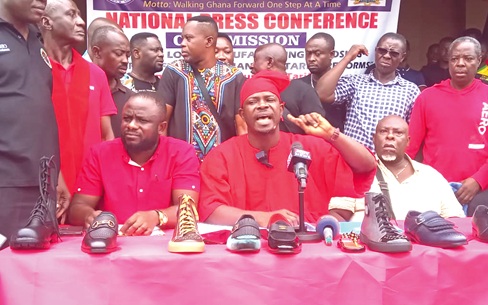
Protect leather industry against cheap imported footwear - Manufacturers association to govt
The Ghana Leather and Footwear Manufacturers Association (GLFMA) has called on the government to take necessary steps to protect the leather and footwear industry from unfair imports.
Addressing a press conference at the Jubilee Park in Kumasi last Tuesday, the President of the association, Gilbert Akwasi Ntim, said the industry that fed thousands of families and sustained local economies was facing deliberate, systematic economic sabotage.
He explained that when they imported raw inputs such as synthetic rubber sheets and off-cut scrap leathers, the Ghana Revenue Authority (GRA) slapped a standard duty of 10 per cent on the materials.
However, after the Integrated Customs Management System (ICUMS) was rolled out, it compounded the duty. In addition to other levies, they were forced to pay 36.1 per cent effective tax just to clear raw materials.
Increasing takeover
Mr Ntim expressed concern about the increasing takeover of Ghana’s footwear market by imported products, particularly from Asia and said “the massive influx of cheap imported footwear was a threat to the survival of Ghana’s leather and shoe industry.
He said data from the Ghana Statistical Service (GSS) revealed that over 70 per cent of footwear sold in Ghana between 2024 and 2025 was imported from China, with a value exceeding $40 million, while the country’s footwear exports remain below $1 million.
“This situation is not just a business issue, but it is a national economic concern as the country’s local footwear industry, with the capacity to employ thousands of people, continues to struggle,” he said.
Economic impact
Mr Ntim said the current and growing import imbalance posed a serious threat to the leather industry as it had wiped out the market share for Ghana-made footwear by over 30 per cent in the past decade.
The President of GLFMA stated that the situation had pushed many local producers out of business, especially small-scale artisans in Kumasi, Accra and Takoradi, adding that it had reduced employment for vocational graduates trained in shoe and leather work.
While indicating that the development had created a $40 million trade deficit in the footwear sector alone, Mr Ntim said, “imported shoes are often cheaper but mostly of poor quality, providing little-long term value for consumers”.
While the association was not against international trade, Mr Ntim said the members would rather have fair trade to prevent the destruction of local industries.
Demands
He called for an urgent government intervention and support to safeguard the local leather industry through an increase in tariffs on finished synthetic and leather goods from outside the African Continental Free Trade Area (AfCFTA) zone.
Additionally, he called for a stop to the misclassification of finished shoes as raw materials at the ports and further advocated increased access to low-interest loans through the Ghana Export and Import (GEXIM) Bank for the purchase of an industrial machine.
While appealing for the implementation of zero import reduced duties on raw materials such as synthetic rubber sheets, insoles, board, glue and leather chemicals used for local production, Mr Ntim said: “This will immediately lower our production cost, thereby allowing their products to compete fairly in price”.
