
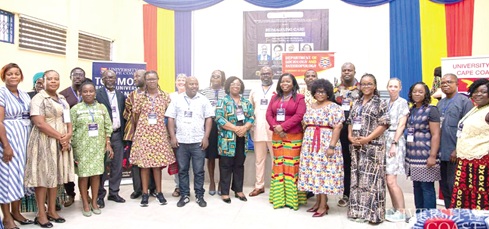
UCC hosts confab on caregiving
The fading culture of communal support in African homes, growing pressure on women as caregivers, and the rising shift towards institutional care systems came under sharp focus at an international conference on caregiving hosted by the University of Cape Coast (UCC).
Participants called on Africans to rethink how care is practised, valued and sustained.
The two-day event, which was on the theme: “Reimagining care: Relationships, responsibilities and care in Africa,” brought together scholars, researchers and participants from across Africa who reflected on the changing nature of caregiving and its implications for families, communities and institutions.
The conference, a collaboration between UCC and the University of Pretoria in South Africa, also examined how African societies could preserve their unique culture of care while adapting to social and economic transformations.
It formed part of a broader Reimagining Reproduction Project, a five-year initiative funded by the Wellcome Trust, which had hosted similar conferences in South Africa, Kenya, Zimbabwe and Tanzania.
Situation of women
The Head of the Sociology and Anthropology Department of UCC, Prof. Georgina Yaa Oduro, said the conference was intended to challenge long-held assumptions about care, particularly the tendency to take caregiving for granted.
She said women, due to social and biological expectations, often shouldered caregiving responsibilities from childhood to old age, yet such efforts were rarely recognised or valued.
Drawing from real-life experiences, she recounted the story of a woman who sacrificed a promising career to care for her ailing mother after her brothers declined responsibility, only to be left struggling after the mother’s death.
“Care has always been with us, but we take it for granted.
This conference allows us to rethink it and pay attention to dimensions we often ignore,” Prof. Oduro added.
She further expressed concern over the gradual decline of extended family systems in Ghana, warning that increasing nuclear family arrangements risked weakening traditional support structures that once formed the backbone of caregiving in African societies.
Foreign cultures
The Dean of the Faculty of Social Sciences at UCC, Prof. Simon Mariwah, cautioned against blindly adopting Western systems where elderly relatives were often placed in care homes.
He said Africa must find ways of preserving its communal values while embracing global changes.
The Provost of the College of Agriculture and Natural Sciences, UCC, Prof. Rofela Combey, also described care as central to Africa’s development and social cohesion that must not be abandoned.
“Reimagining care means recognising the weight and true worth of care.
When we redistribute care equitably and invest in infrastructure, it becomes one of Africa’s greatest engines for human development,” she said.
Invisible labour
Professor of Anthropology and Director of the Centre for the Advancement of Scholarship (CAS) at the University of Pretoria, South Africa, Prof. Nolwazi Mkhwanazi, highlighted the importance of recognising forms of care that often go unnoticed in African societies.
She said that many caregiving roles remained invisible because societies fail to identify them as care, despite their significance in sustaining families and communities.
For his part, the Chair of the Local Organising Committee of the conference, Dr Saibu Mutaru, said the conference was particularly significant because it marked the final year of the project.
