
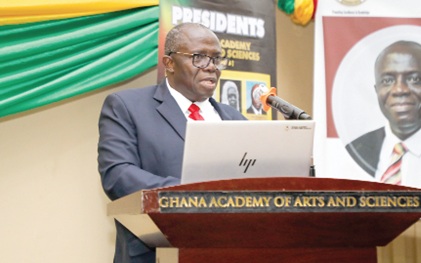
Use music as tool to expose corruption, ills in society — Justice Sir Adjei
A justice of the Supreme Court and Fellow of the Ghana Academy of Arts and Sciences, Sir Dennis Dominic Adjei, has recommended the reintroduction of Ghanaian folklore and music as tools to expose corrupt individuals, especially those involved in illegal mining, also known as galamsey.
He said the act could be as effective in modern-day Ghana as it was in the past to address the ills of society by naming and shaming deviant characters.
The Justice of the Supreme Court was delivering the Ephraim Amu Memorial Lecture at the Ghana Academy of Arts and Sciences (GAAS) in Accra last Thursday evening.
GAAS instituted the lecture in honour of Ghana's composer and musicologist, Dr Ephraim Amu.
This year’s lecture was on the topic: "Advancing human rights through music.”
The lecture was instituted by the Ghana Academy of Arts and Sciences through the initiative of Emeritus Professor J. H. Kwabena Nketia in 1999, a lecturer and an ethnomusicologist.
Use music to appeal
Justice Sir Adjei said several songs had proclaimed human rights principles and had been widely accepted by listeners, and they could be used as an effective tool to advance human rights.
The Supreme Court Justice, who is a chorister and a composer of a new song on galamsey, advocated conscious efforts to integrate human rights content into mainstream Ghanaian music, using local languages and genres, such as gospel and hiplife, to appeal to people living in rural and urban areas.
In that regard, he said, the Ministry of Education may start piloting such songs in moral education.
Also, he said, the Ministry of Lands and Natural Resources, in its quest to fight illegal mining, might provide funding to integrate human rights content that dealt with environmental degradation and pollution and their effect on human life in collaboration with the Ministry of Health, Ministry of Food and Agriculture, as well as the Ministry of Environment,
Science, Technology and Innovation.
In a lively presentation interspersed with choral music, Justice Sir Adjei reminisced about the good old days when music at festivals exposed corrupt people and those who had violated individual rights.
"The National Folklore Board, under the Ministry of Tourism, Culture and Creative Arts, in collaboration with the Ghana Library Authority and appropriate non-governmental organisations, should record, digitise and preserve songs created during social movements, to protect cultural memory from erasure when oral testimony is central.
Funding may be sought through the National Film Authority’s Creative Arts Fund,” he said.
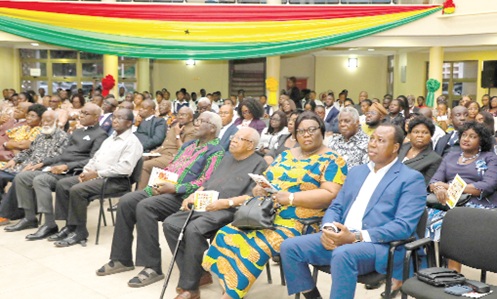
This generated loud cheers from the audience, including the former Speaker of Parliament, Aaron Mike Oquaye; the Asokoremanhene, Dr S. K. B. Asante; the Member of Parliament for Okaikwei Central, Patrick Yaw Boamah; a legal practitioner and member of the ruling National Democratic Congress (NDC), Kakra Essamuah, past presidents of the academy and students, among others.
Platform
Justice Sir Adjei wants the creation of safe platforms for performance and advocacy by district assemblies, churches and mosques, and the National Commission for Civic Education (NCCE) to promote music with rights-based content, and encourage both private and public radio and television stations to allocate pro bono airtime during prime time to have an impact on the people.
In that regard, he suggested that musicians with the right advocacy should be encouraged and rewarded, as well as television and radio stations that played such music during prime time, with tax waivers.
"The festivals that use music to name and shame wrongdoers in their respective communities, such as the Apoo and Alolue festivals celebrated by the people of Bono and Sefwi, respectively, should be used to fight galamsey kinpins within their communities.
"Appropriate bodies should be engaged to conduct studies as to whether music-based interventions have been able to change knowledge and attitudes on the right issues.
The researchers' findings will help justify sustained funding from ministries such as Land and Natural Resources, Environment, and Tourism," he suggested.
The Justice of the Supreme Court also called on the Ministry of Education to ensure that patriotic songs with human rights content were sung during parades and inter-school activities.
The presentation highlighted music as a powerful and essential tool for learning and retention, standing alongside traditional methods such as storytelling, visual aids, group discussion, role-play, and hands-on activities.
"Songs are a universal language that is understood worldwide, irrespective of the language in which they are sung, and they become easy to memorise," Justice Adjei said.
