
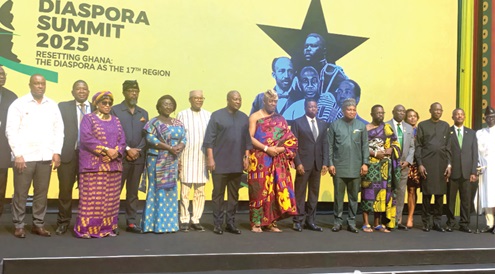
Reparative justice, false narratives... Mahama calls for united African front
President John Dramani Mahama has called on Africans and members of the diaspora across the world to stand united in their pursuit for reparative justice and the elimination of false narratives about Africa.
The President said it was about time Africans flipped the narratives and modus operandi of those who had distorted the African story to suit their interests and to divide Africans.
“Anything in this life, once stripped of its power, will no longer work.
That is true of stories, especially ones that are complete fabrications. Let's take the narrative of those who oppressed us and work it.
“In fact, let's take their entire modus operandi and flip it and reverse it.
I urge you, my brothers and sisters; let's be more intentional about our unity than they were about our division,” he said.
President Mahama was speaking at the Diaspora Summit at the Accra International Conference yesterday.
It was on the theme: “Resetting Ghana: The Diaspora as the 17th Region”.
The President affirmed that with a common purpose, Africans and members of the diaspora would achieve their goal, no matter how they must have been divided, adding that “we've always tried to find our way back to one another.
Africans in the diaspora whose forebears were enslaved have kept us in their rhythms”.
He eulogised Pan-Africanists such as Marcus Garvey and the First President of Ghana, Dr Kwame Nkrumah, for their efforts in rallying for unity between the members of the diaspora and those in Africa.
President Mahama asserted that the Black Star, which featured prominently on Ghana’s flag, had become a defining part of the country’s national identity due to Pan-African ideals, adding that it underscored the Pan-Africanist rallying cry for the unity of all African peoples.
Notice to the UN, Reparation
The President reaffirmed his commitment to move a motion next year at the United Nations (UN) for the recognition of the transatlantic slave trade as the greatest crime against humanity.
He called on all Africans and those in the diaspora to support the motion to fight for reparations from those who benefitted from the injustices of the past.
“I know this motion will enjoy the utmost support from the entire African continent and the diaspora.
Africa has suffered slavery, colonialism, genocide and apartheid.
“We demand acknowledgement of these crimes against humanity.
We demand the establishment of legal, institutional and international mechanisms to advance reparative justice,” he said.
President Mahama also indicated that reparations must include tangible measures such as debt cancellation, monetary compensation, return of stolen artefacts, institutional reform and transformative economic redress in the global economic system.
He added that the African and the diasporan were at a pivotal place in their journey where they must speak about the injustices of the past to counter those who desired for the continent to be set backward.
“They want us to develop some sort of amnesia about the blood that was spilled, the lives that were lost, and the years that were sacrificed in order to fight for our freedom.
We are at a place in our journey where we do not have the luxury of forgetting,” he said.
The President argued that with global figures now using words like garbage and filth to describe Africans, there was no longer the luxury of forgetting or excusing the racist dog whistles or explaining the overtly discriminatory and divisive statements that were made daily to the hearing of Africans.
“This is precisely the time when we must advance and begin the process of reclamation.
This is precisely the time when we must speak loudly and clearly, naming what it is we have lost, as well as what it is we hope to gain,” he stated.
Reparation
For his part, the President of the Council of Ministers of Togo, Faure Gnassingbe, asserted the need for reparations for the transatlantic slave trade and colonisation, stating that it was essential for Africa's development and global stability.
President Gnassingbe stressed that recognising the crimes of the past was not enough as concrete actions and institutions were needed to transform memory into law and faith into progress.
He proposed measures such as debt cancellation, multilateral funds for education, innovation and new legal commitments to the United Nations.
President Gnassingbe also underscored the importance of the African diaspora in achieving sovereignty, and urged collective governance and healing work to address the wounds of the past.
He called for a re-founding of Africa's position in the world based on economic sovereignty, mobility of knowledge and investment in the youth and the diaspora.
