
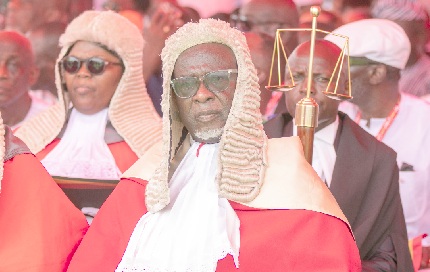
Supreme Court dismisses Wesley Girls' motion to strike out suit
The Supreme Court has dismissed an application seeking to strike out a suit in which a Ghanaian citizen is challenging the constitutionality of certain directives of the Wesley Girls School.
A preliminary legal objection, which was filed by the school, contended that the Board of Governors of Wesley Girls, labelled as a defendant in the suit, did not have the capacity to sue and be sued, and as such, the substantive matter must be dismissed.
Motion
Moving the motion yesterday morning, counsel for the school, Iris Aggrey-Orleans, argued that it was rather the Trustees of the Methodist Church that had the capacity to be sued.
The bench, however, referred counsel to another matter in which the Board of the Achimota School was sued, but counsel informed the court that, unlike Methodist, Achimota School was established by an Act of Parliament and was clothed with a personality to sue and be sued.
The bench further asked the counsel whether it could make orders against the board, but counsel replied that, that was of no moment, adding, "before a body or persons can appear before this court, that body must have personality.
"If you have no business appearing before the court, this court has no business entertaining you," he added.
Justice Tanko Amadu asked counsel, granted your application was granted, can the plaintiff file this action again?" Counsel replied in the affirmative.
Based on this, the bench said it had the authority to economically manage the court to avoid repeating the action since it could even make orders against the Ghana Education Service, a party in the case, which would eventually be binding on the school.
Opposed
Counsel for the plaintiff, Abdul Aziz Gomda, opposed the preliminary legal objection.
Mr Gomda said it was clear that public schools were to be managed by the Board of Governors, which was a statutory creation.
As a result, he argued that the board had legal capacity to be sued since the board was in existence.
The Deputy Attorney-General, Dr Justice Srem-Sai, also opposed the motion, saying it was mounted on an error of law.
He refuted allegations that the Board of Governors were not in existence.
To prove that, he said they had provided them with evidence that the board actually existed.
Ruling
In a ruling, the seven-member panel of the apex court, which had Chief Justice Baffoe-Bonnie as the President, upheld arguments of the Deputy Attorney-General, Dr Justice Srem-Sai, and the plaintiff's lawyer, Abdul Aziz Gomda, saying that board members were competent persons to be sued.
It had, therefore, given the school two weeks to respond to the allegations contained in the suit.
The case had been adjourned indefinitely.
Other members of the panel were Justices Gabriel Scott Pwamang, Senyo Dzamefe, Kwaku Tawiah Ackaah-Boafo, Issifu Omoro Tanko Amadu, Richard Adjei Frimpong, and Sir Dennis Dominic Adjei.
The bench asked the Catholic Church, which filed an amicus, to seek leave of the court before they will be permitted to file the documents.
Background
In a suit filed by a legal practitioner and law lecturer, Osman averred that the school’s admission process mandates signing an undertaking that includes an Institutional Faith Clause, which significantly affects non-adherent students, particularly Muslims.
The school, it said, required such students to participate in Christian practices, such as attending Methodist mass, prayers, and special Christian events.
However, the plaintiff said, Muslim students faced disciplinary actions for possessing Islamic items such as the Quran or hijab, and were also barred from observing Islamic religious practices, including Salat and Ramadan.
Recognition
It further alleged that the school does not recognise Muslim students equally as compared to their Catholic or Anglican peers, thus treating them as second-class citizens.
This policy, Osman argued, undermines the religious and moral upbringing of Muslim students, separating them from their families and communities.
It is based on this that the applicant is seeking to enforce the 1992 Constitution by arguing that the school’s policy unlawfully discriminates against its Muslim students, their parents and communities.
The policies, the plaintiff further averred, unlawfully nullify the right to freedom of conscience and the freedom to believe and practice the religion of its Muslim students, adding that the policy had no justification under Article 21, and that the policies were disproportionate under any regime of limitation.
He, therefore, wants the Supreme Court to declare that these acts by Wesley Girls are inconsistent with Article 12, 17(1)(2), 21(1)(b)(c)(e) 26(1), 33(5) and 46 of the 1992 Constitution.
