
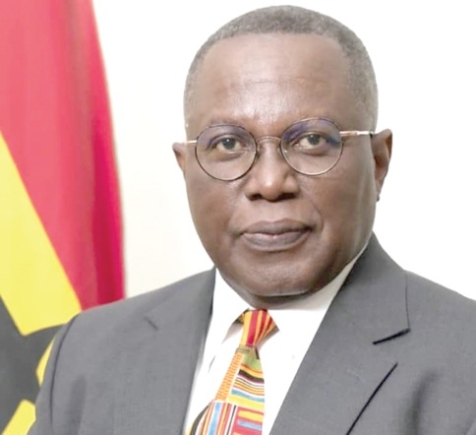
Three-dimensional growth model will strengthen economic balance - NDPC chairman proposes productivity
The Chairman of the National Development Planning Commission (NDPC), Dr Nii Moi Thompson, has proposed a shift in Ghana’s economic measurement framework towards a “Three-dimensional (3D) Growth” model.
He explained that the 3D model was one that placed equal emphasis on Gross Domestic Product (GDP) growth, employment creation and wage growth.
Speaking at the IYA Business Roundtable 2026 in Accra, Dr Thompson asserted that Ghana’s long-standing reliance on GDP as the primary indicator of progress was no longer sufficient, as it often failed to reflect job creation, income levels, and real improvements in citizens’ welfare.
He explained that under the proposed “3D Growth” model, economic performance must be assessed not only by output growth, but also by how effectively the economy generates decent jobs and improved wages.
“Growth without jobs is meaningless. Growth without rising incomes is unsustainable,” he stressed.
Context
Dr Thompson’s proposal, therefore, means that there would be equal emphasis on three dimensions.
First, the traditional measure of economic performance, the GDP Growth which measures growth in the overall output of the economy.
Second is employment creation, which looks at the extent to which economic growth generates decent and sustainable jobs.
Third, the wage growth, which looks at the extent to which economic growth leads to higher incomes and improved earnings for workers.
Caution
Dr Thompson cautioned that without adopting the 3D Growth approach, economic growth risked becoming disconnected from the realities of ordinary citizens, particularly young people entering the labour market each year.
He highlighted structural weaknesses in the economy, noting that although about 92 per cent of businesses operated in the informal sector and accounted for roughly 80 per cent of employment, they contributed only about 27 per cent to GDP.
Dr Thompson emphasised that “achieving the objectives of the 3D Growth agenda will require a strong focus on productivity, formalisation, and value addition across all sectors of the economy”.
He further noted that infrastructure investment under the 3D Growth framework must be assessed not only by physical delivery, but by its impact on jobs, efficiency, and long-term productivity growth.
The NDPC Chairman said key sectors such as electricity, water systems, transport and logistics, and digital infrastructure remained essential drivers of transformation, but must be supported by strong institutions and consistent implementation.
Beyond economic measurement, he pointed to persistent gaps in policy execution, warning that Ghana’s development had been weakened by poor coordination between planning and implementation.
Dr Thompson called for stronger alignment between national development plans and budgetary allocations, as well as improved accountability across public institutions.
The country’s next phase of development must be guided by the principles of 3D Growth, he said.
The Chief Executive Officer of Ishmael Yamson and Associates, Ishmael Yamson, urged Africa to move beyond narratives of potential and commit to aggressive execution and wealth retention.
He said the continent had become too comfortable with the “Africa Rising” narrative, despite its vast resources and economic potential.
“Potential without aggressive execution is simply prolonged failure,” he stated, adding that Africa’s current growth model remains largely extractive.
Mr Yamson criticised the continued reliance on GDP as a primary measure of progress, arguing that it often masked structural weaknesses in African economies.
“When foreign conglomerates extract lithium from our soil and repatriate the profits offshore, our GDP rises, and we celebrate, yet little value remains within our economies,” he said.
He called for African businesses to deepen cross-border collaboration under the African Continental Free Trade Area (AfCFTA) through joint ventures capable of building competitive continental enterprises.
