
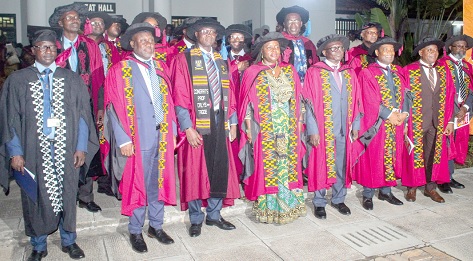
UG Professor outlines practical measures to curb rising cancer cases
The Head of the Department of Community Health at the University of Ghana Medical School (UGMS), Professor Benedict N. L. Calys-Tagoe, has outlined a set of practical, community-driven and policy-focused measures to address the rising burden of cancer in the country.
He stressed that while cancer incidence and mortality were increasing, the country possessed the tools to significantly reduce cases through prevention, early detection, strengthened health systems and improved financing.
“The cancer burden is rising in Ghana.
That is a reality. It doesn't sound very pleasant, but that is the reality.
But the good news is that more than a third of the common cancers that we experience in Ghana are preventable because they are largely infection-related or lifestyle-related and that gives us a window of hope in taming the crab,” he said.
Prof. Calys-Tagoe was speaking at his inaugural lecture held in Accra last Thursday.
It was on the topic: “Taming the Crab: Insights into Cancer Care in Ghana”.
Outlook
The UG professor, who also has expertise in epidemiology, disease control and surveillance, painted a worrying picture of the country’s cancer outlook, emphasising that the country records about 28,000 new cases and 18,000 deaths annually.
With the ongoing epidemiological transition, non-communicable diseases such as cancer were becoming more prevalent and projections suggested that by 2030, cancer cases could surpass malaria, tuberculosis and HIV combined.
Ghana’s control
On cancer control, Prof. Calys-Tagoe explained more than a third of cancers in the country were preventable through lifestyle changes, vaccination and reduced exposure to risk factors.
Another third, he said, could be cured if detected early through screening, while the remaining cases require palliative care.
Despite performing relatively well in HPV vaccination, achieving about 84 per cent coverage among girls, close to the World Health Organisation’s 90-70-90 target of vaccinating 90 per cent of girls by age 15, the community health specialist observed that screening programmes remained largely opportunistic and uncoordinated, limiting their effectiveness.
Gaps
He identified several gaps undermining cancer care nationwide, including geographic inequities that concentrate services in urban centres, leaving rural populations underserved.
Prof. Calys-Tagoe cited limited pathology and imaging capacity, high out-of-pocket costs and delayed diagnoses as key challenges.
Additionally, low screening uptake, weak cancer registry systems and inadequate psychosocial support further compounded the problem.
Solutions
To address these challenges, Prof. Calys-Tagoe called for leveraging the nation’s about 7,000 Community-based Health Planning and Services (CHPS) compounds to sustain nationwide awareness campaigns and expand grassroots screening through trained community health officers.
“Assuming each CHPS compound received five clients per day, making 150 in a 30-day month, that’s over 12 million people per year at the primary care level. And assuming those were even repeat visits, we would still reach about six million people,” he said.
He equally advocated scaling up HPV and Hepatitis B immunisation, integrating palliative care into primary healthcare and reforming the National Health Insurance Scheme (NHIS) to cover comprehensive cancer services.
“We need to find innovative ways of enhancing our insurance. Could we start looking at a tier system where, beyond the basic health insurance, people will be made to pay additional premiums based on their risk, so that there will be more funds available?” Prof. Calys-Tagoe queried.
He further stressed the need to establish and sustain functional cancer registries to support data-driven planning, while investing in training specialised personnel, including oncologists, pathologists and psychologists to address both clinical and psychosocial aspects of cancer care.
Steering actions
The UG Vice-Chancellor, Prof. Nana Aba Appiah Amfo, who chaired the function, emphasised that it should go beyond academic discourse to inspire concrete action to address the country’s cancer burden.
