
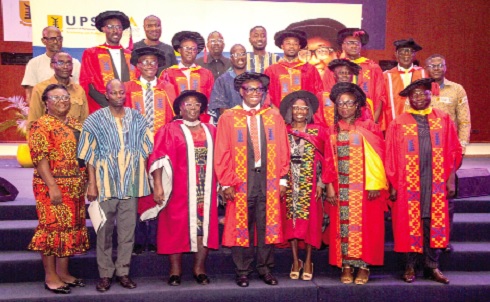
UPSA Prof. Puni proposes shift in SOE leadership appointments
A Professor of Management at the University of Professional Studies, Accra (UPSA), Prof. Albert Puni, has called for a cultural shift in the appointment of leaders of State-Owned Enterprises (SOEs) to ensure competence and accountability for sustainable national development.
He suggested that the government should adopt a merit-based system guided by a proposed Three-C model — competence, commitment and character — in selecting board members and chief executives.
He also recommended that the State Interests and Governance Authority (SIGA) should develop and manage a pool of vetted (pre-qualified) directors and chief executive officers (CEOs) to support transparent and competitive recruitment.
Delivering his inaugural lecture at UPSA last Friday, Prof. Puni advised that while new Presidents may dissolve SOE boards upon assuming office, the termination of CEOs should be delayed for at least three months to allow newly constituted boards to participate in their appointment.
The inaugural lecture was on the topic: “State-owned enterprise governance: Towards a sustainable board and CEO selection and appointment process for national development”.
In attendance were the Chancellor of the university, Dr K. K. Sarpong; the Vice-Chancellor of UPSA, Prof. John Kwaku Mensah Mawutor; the Registrar of the university, Lorraine Buerkie Gyan; former Pro-Vice Chancellor, Prof. Charles Bannor; the Chairman of the Public Services Commission, Prof. Victor Agyeman; the Vice-President of the Institute of Directors, Justice Michael Ashong, and other dignitaries.
Prof. Puni explained that appointing the right leaders with integrity and skill would help reverse SOEs’ chronic losses and set a benchmark for good governance across Corporate Ghana.
“To reverse the chronic loss-making situation of Ghanaian SOEs and promote sustainable development, there must be a cultural change in the selection and appointment process.
“Appointing authorities should prioritise choosing leaders with the right skills and mindset, setting an example that the rest of Corporate Ghana can emulate for the sustainable growth of both SOEs and privately owned companies,” he said.
Ghanaian context
The management professor stated that state-owned enterprises constituted a significant component of the global economy, particularly in developing nations such as Ghana.
However, Prof. Puni said the mainstream economic analysis consistently identified SOEs as perennial underachievers, characterised by chronic financial losses and performance that lagged behind privately owned enterprises (POEs).
“The Ghanaian context aligns with this conventional perspective. Most Ghanaian SOEs have been making losses since the 1960s, a situation that led to the closure and privatisation of many by the National Liberation Council on the recommendation of the World Bank (Potter, 2015).
“This trend of poor financial performance persists today. As recently as 2024, SOEs in Ghana reported a collective net deficit of GH¢2.40 billion,” Prof. Puni stated.
Persistent losses
The management professor explained that the persistent financial losses and governance failures in Ghana’s state-owned enterprises were rooted in a fundamental flaw — the ineffective and politically influenced process of selecting and appointing board members and chief executive officers.
Prof. Puni said the historical conception of board appointment was rooted in the fiduciary accountability of medieval guilds, where elected members were tasked with protecting owner interests by ensuring ethical and prudent conduct for all stakeholders.
Consequently, the professor said a transparent and merit-based appointment process was a prerequisite for competent and ethical corporate behaviour.
“This is supported by corporate governance theories, which advocate selecting competent and ethically minded individuals for these critical management and oversight positions.
“Unfortunately, Ghanaian SOEs are performing poorly because appointing authorities are not applying independent, technocratic, and merit-based processes for the selection and appointment of the board of directors and CEOs,” he added.
