
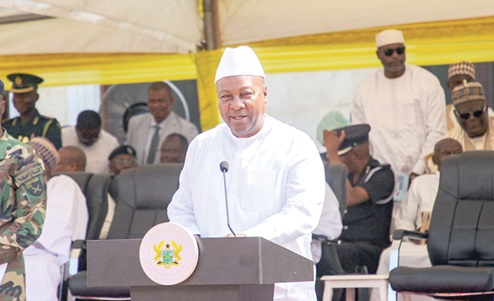
Use Ramadan month to strengthen national peace, unity - President admonishes Muslims
President John Dramani Mahama has extended warm felicitations to the Muslim community in this month of Ramadan, describing it as a month of reflection, renewal and unity.
“Let us use this holy month to strengthen the bonds of unity, love, and peace in our communities and across our beloved nation.
“From my family, we wish you a spiritually fulfilling and blessed Ramadan,” the President said in a message released last Friday.
Ramadan, which began last week, is a period of fasting observed by Muslims in the ninth month of the Islamic calendar to help them attain piety, as prescribed in the Holy Quran.
It is one of the Five Pillars of Islam observed for either 29 or 30 days, depending on the sighting of the moon. It culminates in the celebration of Eid al-Fitr, the Muslim festival.
Spiritual reset
In a related development, the Assistant Public Relations Officer of the National Mosque of Ghana, Mallam Musah Nuhu, described Ramadan as a month of “spiritual reset” for Muslims, explaining that the holy month was designed to draw believers closer to Allah and strengthen moral discipline.
In an interview with the Daily Graphic, he said Ramadan was not only about abstaining from food and drink from dawn to sunset, but also about renewing one’s faith, purifying the heart, and reforming behaviour.
“Ramadan is a pillar of Islam and a commandment from Allah. For a Muslim to be complete in his faith, he must observe the fast,” Mallam Nuhu added.
Quoting from Surah Al-Baqarah, he said: “O you who believe, fasting has been prescribed upon you as it was prescribed upon those before you, that you may attain piety.”
He emphasised that the phrase “that you may attain piety” signified certainty, stressing that sincere fasting inevitably strengthened one’s consciousness of God.
Mallam Nuhu said fasting went beyond physical hunger and thirst.
“The eyes must fast, the tongue must fast, the hands must fast, and even the thoughts must fast,” he added.
The Islamic cleric further said that Muslims were required to refrain from all forms of immoral conduct, dishonesty and harmful speech.
“This is why we say Ramadan is a spiritual reset. It makes you pause, reflect and realign your actions with the will of Allah,” the cleric said.
Exemptions
Mallam Nuhu also explained that the Islamic law exempted certain categories of people from fasting. They include the sick, travellers, menstruating women, nursing mothers and those who have recently given birth (lactating mothers).
“Islam does not intend hardship. Allah wants ease for us, not difficulty,” he said, adding that those exempted were, however, required to make up for the missed days when they could.
Touching on the social dimension of Ramadan, Mallam Nuhu said the month was characterised by increased charity, generosity and community bonding.
He explained that acts of worship performed during Ramadan attracted multiple rewards.
“If you feed one fasting person, your reward is doubled. Good deeds in Ramadan are multiplied many times over,” he said.
Lessons
Mallam Nuhu said that the experience of hunger cultivated empathy in the wealthy and encouraged support for the poor and vulnerable.
“Ramadan teaches compassion. When you feel hunger for hours, you understand the plight of the less privileged,” he said.
He added that communal iftars (meals) and shared prayers fostered peaceful coexistence and strengthened bonds among Muslims and between Muslims and non-Muslims.
