
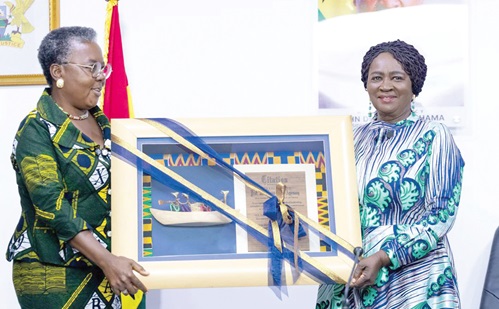
Vice-President calls for innovative ways to protect marine environment
The Vice-President, Professor Naana Jane Opoku-Agyemang, has urged leaders in the fisheries sector to adopt innovative practices and strengthen the protection of the country’s marine environment, citing growing threats to Ghana’s marine ecosystem.
She noted that pollution from illegal mining activities, plastic waste and the dumping of toxic substances into the sea are increasingly depleting fish stocks and undermining the livelihoods of coastal communities, stressing the urgent need for these harmful practices to end.
Speaking during a working visit to the Ministry of Fisheries and Aquaculture in Accra yesterday, the Vice-President said, “Galamsey waste seeping into the sea should not be encouraged at all. Dumping toxic waste into our seas is worrying because all of these affect the livelihood of the fish that we need to feed ourselves,” she said.
Prof. Opoku-Agyemang stressed that food security and coastal livelihoods depended on how well the country managed its aquatic resources.
She shared examples of modern fisheries systems she had encountered abroad, which she said offered valuable lessons for the country.
On the issue of overfishing, the Vice-President shared insights from international experiences, particularly in Japan and South Korea, where fisheries education was institutionalised through secondary schools and research facilities.
She said such initiatives could be revived and expanded locally to support sustainability and food security.
The visit
The visit to the Ministry of Fisheries and Aquaculture was part of the Vice-President’s working visits to various ministries, departments and agencies in the country, especially those headed by women.
She had earlier visited the ministries of Gender, Children and Social Protection, Tourism, Culture and Creative Arts, as well as Education, Health, and Trade, Agribusiness and Industry.
Prof. Opoku-Agyemang was accompanied by the Chief of Staff in her office, Alex Percival Segbefia and other staff.
The Minister of Fisheries and Aquaculture, Emelia Arthur, together with management, staff and heads of agencies under the ministry, received the Vice-President.
Commitment
Prof. Opoku-Agyemang reaffirmed the government’s commitment to working closely with the ministry and other stakeholders to improve the livelihoods of fishing communities and ensure a sustainable, resilient fisheries sector.
She described fishermen as highly skilled individuals who were largely self-trained, able to read weather patterns, navigate the sea and survive under difficult conditions.
“It is our responsibility to give fishermen the support they need, raise their quality of life and show them the respect they deserve. How does someone’s profession that sustains us become a weapon of disrespect?”
She said that many fishermen work beyond a 24-hour work cycle, sometimes spending several days at sea, yet they are not asking for excessive support but for fair opportunities to contribute to the national economy.
“Fishermen are not asking for the moon; they are asking for an opportunity to contribute to the economy. This cannot be wrong,” Prof. Opoku-Agyemang said.
Drawing on her roots in Komenda, a fishing community in the Central Region, the Vice-President said “I come from a fishing village and the fishermen will tell you that there is wealth in the waters. So let us find ways to bring this wealth out for the benefit of fishermen and our fishmongers.”
Fish production
Providing a situational report, the Minister of Fisheries revealed that about 60 per cent of the country’s animal protein came from fish, most of which was supplied by artisanal fisheries.
Ms Arthur, however, said that declining fish stock had significantly reduced supply, making it difficult to meet growing demand.
She said the shortage of fish went beyond an economic challenge and must be viewed as a national concern.
Ms Arthur announced that the ministry would partner and work closely with the 24-Hour Economy Secretariat under the Volta Economic Corridor Agenda to expand agricultural production and increase fish production.
She further stated that the ministry was implementing measures to have the European Union’s yellow card lifted.
The measures, she said, included introducing a new and comprehensive law to address the identified gaps.
