
World Environment Day: Nature under siege in the name of survival
The Bible verse is a powerful reminder that the Earth does not belong to man.
Forests, rivers, animals, fertile lands, and every natural resource are gifts entrusted to humanity by God to be protected and preserved for future generations.
Yet, across many farming communities along the Wenchi-Wa and Wenchi-Nsawkaw-Banda highways, that sacred responsibility is gradually fading.
Charcoal production
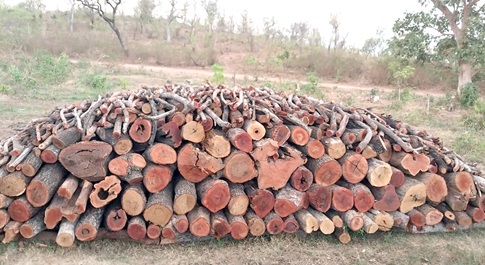
Forests that once provided shade, rainfall, food, and livelihoods are being steadily cut down for charcoal production.
Rows of charcoal sacks lined along the highways tell a painful story of environmental destruction unfolding quietly in parts of the Bono Region.
From Nsawkaw to Menji in the Tain District, trees are being felled in large numbers for charcoal production, while illegal mining activities, popularly known as galamsey, continue to leave deep scars on the land, destroy vegetation and threaten water bodies.
Environmental implications
The Head of the Department of Atmospheric and Climate Science at the University of Energy and Natural Resources, Dr Caleb Mensah, said the excessive use of firewood and charcoal had serious environmental and health implications.
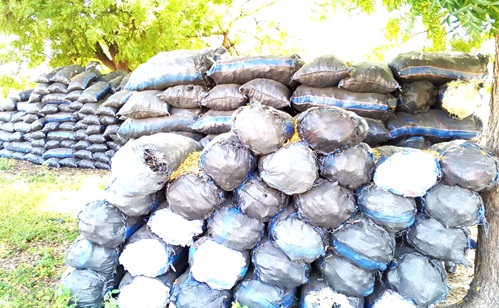
Bags of charcoal packed at Branam on the Wenchi-Wa highway waiting to be transported to the cities.
He explained that the large-scale harvesting of wood for charcoal production contributed significantly to deforestation, while the burning process released harmful greenhouse gases into the atmosphere, worsening global warming and climate change.
Dr Mensah said forests served as important carbon sinks that absorbed greenhouse gases, stressing that the continuous destruction of trees would weaken efforts to protect the environment.
Respiratory diseases
He added that people living close to charcoal-burning sites were also prone to respiratory diseases due to prolonged inhalation of smoke.
According to him, although the government had introduced policies to promote cleaner energy alternatives such as Liquefied Petroleum Gas (LPG), electric and bioethanol stoves, challenges such as affordability, accessibility and cultural beliefs continued to hinder public acceptance.
“Some people believe food prepared with charcoal tastes better than food cooked with gas, while others struggle to access LPG in rural communities,” he said.
Dr Mensah underscored the need for public education, subsidies and stronger community involvement in promoting clean energy alternatives.
Struggle for survival
While the Bible teaches stewardship and care for creation, economic hardship and the struggle for survival are pushing many people, especially the youth, to exploit the very environment that sustains them.
The rows of charcoal sacks seen along the roadsides have become symbols of both survival and destruction.
Undoubtedly, behind every sack is a fallen tree, leading to a wounded environment and a growing crisis that threatens livelihoods, biodiversity and future generations.
World Environment Day
Ahead of World Environment Day on Friday, June 5, the situation raises difficult questions about humanity’s responsibility towards the environment and the kind of future being created for generations yet unborn.
Travelling through sections of the highways, one cannot ignore the evidence of environmental degradation.
Freshly cut logs are scattered across the bush, while charcoal kilns release thick smoke into the atmosphere.
The once-fertile, green landscape is gradually being degraded, raising serious concerns about environmental sustainability and the future of farming in the affected communities.
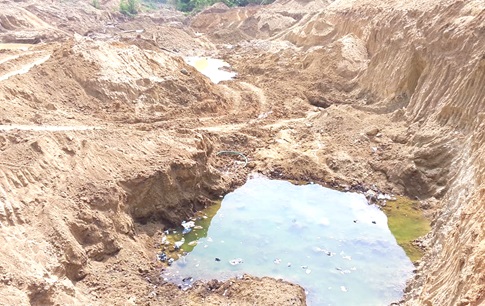
A galamsey pit left uncovered at Nipanikrom
What used to be green belts that provided shade, medicinal plants, wildlife habitats and rainfall protection are becoming dry and exhausted landscapes.
Unemployment
Residents say the charcoal business has intensified over the years due to economic hardship, unemployment and rising urban demand for charcoal as a cheaper cooking fuel.
At a charcoal production site near Subinso No.1, smoke rose heavily from a mound of slowly burning logs as men and women busied themselves covering kilns with mud.
One of the producers, Benjamin Atoa, admitted that although they knew cutting down trees was harmful, charcoal production remained their main source of livelihood.
“There are no jobs here.
This is what feeds our families,” he said.
Nearby, women packed charcoal into sacks while children played close to the smoky pits, inhaling fumes that health experts warn could contribute to respiratory diseases.
For many families, charcoal production has become not just a business but a survival strategy.
Illegal mining
Also, the activities of illegal mining (galamsey), particularly at Nipanikrom, Surubokrom, Operator, near Bandaboase in the Banda District and Branam in the Wenchi Municipality, have left vast stretches of land stripped bare, exposing the soil to severe erosion and scorching heat.
Their activities are quietly eating away at parts of the region, as excavators dig recklessly into fertile farmlands, leaving deep, uncovered pits and polluted streams behind, while chemicals used in the extraction process threaten aquatic life and water bodies.
In communities such as Nipanikrom, Branam and Surubokrom, farmers say crop yields are declining due to land degradation and changing rainfall patterns.
A farmer at Nipanikrom, Yaw Fosu, told the Daily Graphic that rainfall patterns in the area had become unpredictable.
“The charcoal burners and galamsey activities are destroying the same environment that gives us food,” he lamented.
Research indicates that the combined effects of illegal mining and excessive tree felling are creating a dangerous ecological imbalance.
Trees play a critical role in protecting the soil, regulating temperatures, preserving biodiversity and absorbing carbon dioxide from the atmosphere.
Climate change
Their destruction contributes directly to climate change, rising temperatures and unpredictable weather conditions.
Without urgent intervention, environmental experts fear parts of the area could gradually experience desertification.
Ironically, evidence of the destruction is displayed openly along the highways, where several sacks of charcoal wait daily for transport to urban centres.
The sight has become so common that many travellers barely notice it anymore.
However, environmental observers warn that normalising such destruction is dangerous because it creates the impression that the environment has little value.
With forests disappearing, animals lose habitats, streams dry up and farming systems become increasingly vulnerable.
SDGs
The destruction also undermines several global development commitments, particularly the United Nations Sustainable Development Goals (SDGs), including Goal 13 on climate action, Goal 15 on life on land, Goal six on clean water and sanitation and Goal three on good health and well-being.
At Menji in the Tain District, residents told the Daily Graphic that they were not enemies of the environment but were trapped between poverty and survival.
A resident, Ibrahim Yussif, blamed the growing destruction on the lack of alternative livelihoods and limited rural development opportunities.
Another resident, Asana Mariama, who trades in charcoal, said demand for charcoal remained high because many households could not afford cooking gas.
“People in the cities buy it every day. As long as there is demand, people will continue producing it,” she said.
A retired educationist at Namasa, Samuel Adu Appiah, warned that allowing the destruction to continue unchecked could have devastating long-term consequences for both rural and urban populations.
He said the country was already battling rising temperatures, erratic rainfall, flooding and drought conditions linked in part to environmental degradation and climate change.
For his part, the Sunyani Municipal Environmental Health Officer, Daniel Owusu Korkor, warned of the health risks associated with excessive reliance on firewood and charcoal.
“You know, we always say that when the last tree dies, the last man also dies,” he said.
Mr Korkor explained that forests play a critical role in providing oxygen and maintaining environmental balance, warning that the continued destruction of trees could have severe consequences for human survival.
He said smoke generated from firewood and charcoal exposed users to health complications, particularly among producers and users.
According to him, poverty remained one of the major reasons many people continued to rely on charcoal and firewood despite the associated dangers.
Warning
The Bono Regional Deputy Director of the Forestry Commission, Richard Kofi Kyei, warned that the continuous dependence on charcoal and firewood was contributing significantly to deforestation and climate change.
He explained that forests served as important carbon sinks, absorbing greenhouse gases, stressing that the increasing cutting of trees for charcoal production was worsening rising temperatures and erratic rainfall patterns.
“Our continuous use of charcoal and firewood as a source of energy is really having an impact on the forests,” he said.
Mr Kyei said that although alternatives such as LPG and electric cookers existed, many households still relied on charcoal because it was cheaper, more accessible and readily available, especially in rural communities.
He said the Commission had intensified public education and introduced measures to discourage indiscriminate charcoal production, including the introduction of charcoal conveyance certificates for transporters, levies and charges on commercial charcoal production.
Time to act
The Chief Executive Officer (CEO) of the Global Media Foundation (GloMeF), Rapheal Godlove Ahenu, told the Daily Graphic that environmental protection could not be left to the government alone.
He called for stricter enforcement against illegal mining and indiscriminate tree felling, as well as climate-smart agriculture, vocational training and renewable energy alternatives to reduce dependence on charcoal.
Mr Ahenu also stressed the need for intensified public education to help communities understand that protecting the environment was ultimately protecting human life itself.
Conclusion
As the world marks World Environment Day, the scenes along the Wenchi-Wa and Wenchi-Nsawkaw-Banda highways remain a painful reminder that environmental destruction is no longer a distant threat but a harsh reality confronting many communities.
The endless rows of charcoal sacks, the deep scars left behind by galamsey activities and the disappearing forests all point to one truth: nature is under attack, largely in the name of survival.
There is, therefore, the urgent need for stricter enforcement of laws against illegal mining and indiscriminate tree felling, coupled with intensified public education and affordable clean energy alternatives to help communities balance economic survival with environmental sustainability.
Writer’s email:
