
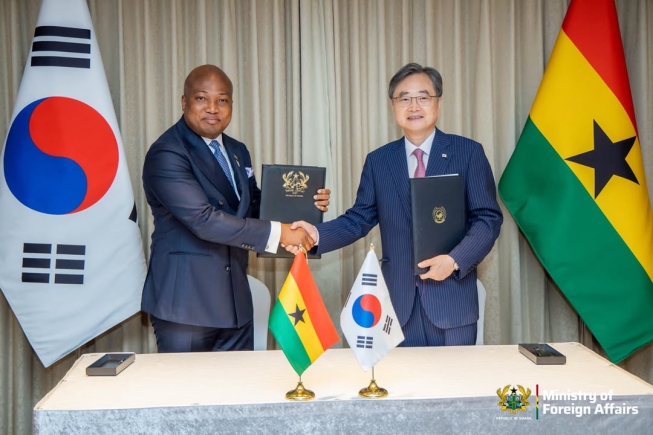
Ghana, South Korea sign visa waiver agreement
Ghana and South Korea have signed a visa waiver agreement that allows holders of diplomatic and service passports to travel between the two countries without visas.
The agreement was signed in Seoul by the Minister of Foreign Affairs, Samuel Okudzeto Ablakwa, and his South Korean counterpart, Cho Hyun, on the sidelines of the Korea–Africa Foreign Ministers’ Meeting held on Monday, June 1, 2026.
The move comes after five decades of bilateral relations between the two countries.
The Korea–Africa Foreign Ministers’ Meeting in Seoul brought together ministers from across the continent to deepen diplomatic and economic ties with South Korea.
Delivering his address as co-chair of the meeting, Mr Ablakwa praised the longstanding relationship between Ghana and South Korea and called for enhanced economic cooperation and trade between South Korea and Africa.
New dynamic leadership
The Minister said Africa now has a new dynamic leadership determined to negotiate on fair terms and to ensure that African resources are exploited in the best interests of the African people.
Mr Ablakwa said the continent was pursuing transformative partnerships that create jobs, promote innovation and strengthen productive capacity.
“Africa now has a new dynamic leadership determined to negotiate on fair terms and to ensure that African resources are exploited in the best interests of the African people,” he said.
He affirmed that efforts were underway across the continent to accelerate industrialisation, improve infrastructure, promote digital transformation, strengthen regional integration and create opportunities for sustainable economic growth.
Support
Mr Ablakwa celebrated South Korea’s “unwavering support” for the landmark UN resolution led by Ghana, A/RES/80/250, which declared the transatlantic enslavement as the gravest crime against humanity.
“South Korea was unflinchingly behind us in this quest for historical justice and truth, and you voted with 123 UN member states. When history is told, the inspirational support of South Korea will eternally be remembered,” he stated.
He said Africa and Korea shared a history of defeating colonialism and imperialism, recalling that 1945, the year South Korea attained independence from Japan, was the same year the Fifth Pan-African Congress was held in Manchester. That Congress, he said, “lit the torch” that led to Ghana becoming the first independent state in Sub-Saharan Africa on March 6, 1957.
Mr Ablakwa said Africa, with a median age of 19.5 and a population of 1.4 billion, possessed abundant natural resources, expanding markets and dynamic innovation ecosystems.
South Korea, he stated, had demonstrated global competitiveness in industrialisation, technology, innovation, education and manufacturing.
“Together, we have an opportunity to build partnerships that move beyond traditional models of cooperation towards transformative economic collaboration,” he said, citing trade, infrastructure, technology, education, agriculture, renewable energy, climate resilience and public health as key areas.
Mr Ablakwa said institutions such as the Korea International Cooperation Agency and the Korea-Africa Foundation continued to contribute to capacity building, technical cooperation, skills development and knowledge sharing across the continent.
Industrialisation
The Minister stressed the need to support Africa’s industrialisation agenda, strengthen local value addition and promote resilient value chains.
He expressed hope that the meeting would consolidate momentum from the 2024 Korea-Africa Summit and identify new avenues for cooperation in digital innovation, green growth, energy transition, critical minerals development, food security and job creation.
Mr Ablakwa also backed the urgent need for United Nations reforms, adding that he had discussed with South Korean Foreign Minister Cho Hyun how both sides could advance the ideals of the Ezulwini Consensus.
He commended South Korean Prime Minister Kim Min-seok for prioritising Africa-Korea partnerships, stressing that the Prime Minister had hosted President John Mahama and visited African countries within months of assuming office.
Ebola scare
The Minister commended South Korea for keeping faith with the meeting despite the Ebola scare in a few African countries, saying the gesture showed that Seoul would not stigmatise Africa or engage in “hasty generalisation.”
