
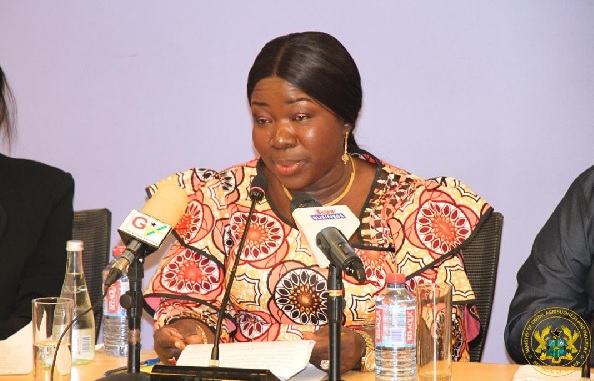
Ghana to shift from raw material exports to job-creating economy – Trade Minister
The Minister for Trade, Agribusiness and Industry, Elizabeth Ofosu-Adjare has called for a bold rethinking of Ghana’s trade strategy to help drive sustainable growth, industrial transformation, and job creation.
Speaking at a joint World Bank–ACET–ISSER seminar on the theme “Rethinking Trade for Growth and Jobs in Ghana” in Accra on Thursday [May 7, 2026], she said Ghana has reached a critical moment in its economic recovery and must now focus on building a resilient, value-driven economy.
Mrs Ofosu-Adjare noted that while Ghana has recorded significant macroeconomic gains, including a historic trade surplus of US$13.6 billion in 2025 and record international reserves, the country must not become complacent.
According to her, the impressive figures reflect deliberate reforms and disciplined economic management under the leadership of President John Dramani Mahama, but emphasized that true prosperity will come only through industrialization, value addition, and export diversification.
She highlighted the government’s commitment to transforming Ghana from a raw material exporter into a self-reliant, import-substituting, and export-led economy.
The Minister explained that the country is already making strides in this direction, particularly through increased processing of cocoa and reforms in the gold sector among others.
She said Ghana’s non-traditional exports reached a record US$5 billion in 2025, representing a 30.7 percent increase over the previous year, with processed and semi-processed goods contributing over US$3 billion. Cocoa derivatives, including paste, butter, and powder, emerged as the highest earners, reinforcing the importance of value addition before export.
She further stated that Ghana has set a target to process at least 50 percent of its cocoa domestically and has already installed grinding capacity exceeding 500,000 metric tonnes to support that ambition. Similar efforts, she said, are underway in the gold sector to ensure more value is retained within the country.
At the Ministry level, she said engagements with manufacturers, exporters, trade associations, and other stakeholders are ongoing to address operational bottlenecks, improve quality standards, and strengthen the competitiveness of Ghanaian products on international markets.
She also highlighted the Ministry’s flagship "Feed the Industry Programme" which seeks to ensure a reliable supply of quality raw materials for domestic industries, explaining that the initiative is critical to addressing the long-standing challenge of under-capacity production within the manufacturing sector.
On regional and international trade cooperation, she disclosed that Ghana continues to advocate for the harmonisation of trade standards within the ECOWAS region to improve competitiveness under the African Continental Free Trade Area (AfCFTA). She added that bilateral engagements are also ongoing to address cross-border trade challenges and improve trade compliance.
Mrs Ofosu-Adjare commended the World Bank, the African Center for Economic Transformation (ACET), and ISSER for convening the seminar, describing it as an important platform for evidence-based dialogue to shape Ghana’s economic future.
To conclude, she called on policymakers, researchers, development partners, and private sector actors to work collectively towards building a stronger and more competitive Ghanaian economy through strategic trade reforms.
Certification ecosystems
The World Bank Regional Director, Seynabou Sakho, in a welcome address said Ghana can benefit more from trade by streamlining logistics, enhance quality certification ecosystems and addressing sector-specific constraints.
Trade, she stated, has the potential of substantially driving growth and job creation, and called for enhanced strategies and reforms to enable Ghana utilize trade to achieve sustained growth and job creation.
