
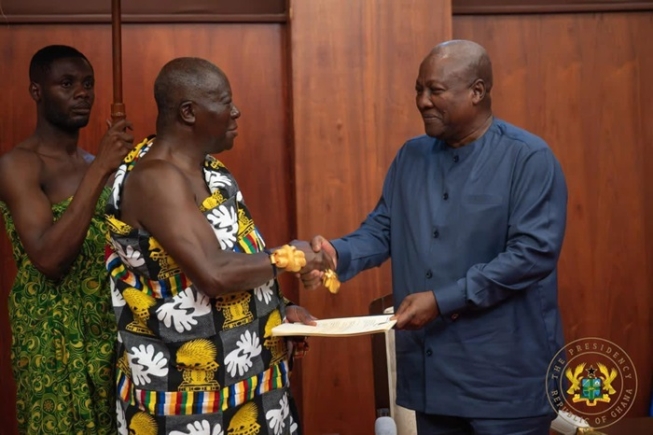
The government has endorsed the findings and recommendations contained in the Bawku Conflict Mediation Report presented by the Asantehene, Otumfuo Osei Tutu II, and announced the creation of a GH¢1 billion fund to support the recovery and development of the conflict-affected area.
In a statement issued on December 17, 2025, and signed by the Spokesperson to the President and Minister for Government Communications, Mr Felix Kwakye Ofosu, the government said President John Dramani Mahama had directed the Minister for Finance to establish the Bawku Revitalisation Fund to restore stability and economic activity in Bawku and its surrounding communities.
According to the statement, the fund will be disbursed over three years from 2026 to 2028 and will be used to reconstruct and develop priority infrastructure, including roads, health facilities, schools, dams and irrigation systems to support year-round agriculture, security installations and commercial facilities. The government said the objective is to restore Bawku’s status as a key economic and trading hub in northern Ghana.
The statement said the government had accepted all the findings and recommendations in the mediation report and would implement them without delay.
It reaffirmed the position of the law, as upheld by the Supreme Court, that Naba Asigri Abugrago Azoka II is the lawful Bawku Naba, stressing that no individual or group is permitted to challenge his authority or legitimacy.
On the status of Alhaji Seidu Abagre, who was installed by the Nayiri as a rival claimant to the Bawku skin in February 2023, the government said it had accepted the Asantehene’s recommendation for his recall. It said Alhaji Abagre is to be recalled to Nalerigu by the Nayiri, the Overlord of Mamprugu, to assume another traditional role, with the support of the state.
The statement said the government would immediately facilitate his safe movement to Nalerigu, where he is expected to remain available to receive the directives of the Nayiri.
It further indicated that Otumfuo Osei Tutu II has been requested to continue offering guidance to subsequent reconciliation efforts aimed at improving relations between the Mamprusi and Kusasi communities.
The Management of the Bawku Revitalisation Fund will be overseen by a committee chaired by the Minister for Finance, Mr Cassiel Ato Baah Forson, who also serves as Acting Minister for Defence. Other members include the Upper East Regional Minister, Mr Donaltus Akamuguri, and the Majority Leader and Leader of Government Business, Mr Mahama Ayariga, who is also the Member of Parliament for Bawku Central and will represent MPs from the area.
The government acknowledged that the prolonged conflict has resulted in significant human, social and economic losses, disrupting livelihoods and stalling development in Bawku and neighbouring communities. It noted that years of insecurity have discouraged both public and private investment and delayed critical infrastructure projects.
The statement appealed to traditional authorities, political leaders, youth groups, civil society organisations, religious bodies, development partners and residents to support the peace and reconciliation process with restraint and unity.
It reiterated the Asantehene’s position that the mediation process produces no winners or losers and urged all parties to accept and abide by the conclusions and recommendations of the report in the interest of national stability.
According to the statement, the report does not seek to assign blame or declare victory, but rather provides a roadmap towards lasting peace.
The mediation process, which lasted two and a half years, was initiated under former President Nana Addo Dankwa Akufo-Addo and continued under President Mahama, with both the New Patriotic Party and National Democratic Congress administrations agreeing that Otumfuo’s recommendations would be binding.
The Bawku chieftaincy dispute, largely between the Kusasi and Mamprusi ethnic groups over the right to occupy the Bawku skin, has for decades resulted in recurring violence, loss of lives, destruction of property and persistent security challenges in the Upper East Region.
The government said its endorsement of the mediation report and the steps outlined to implement its recommendations signal a renewed effort to end the long-running conflict and restore peace and development to the area.
