
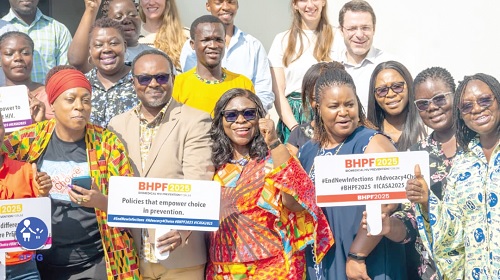
Ghana takes over leadership of Biomedical HIV Prevention Forum
Ghana has been appointed as the Chairperson of the Biomedical HIV Prevention Forum (BHPF).
The Biomedical HIV Prevention Forum (BHPF), an official ICASA pre-conference event, focuses mainly on HIV findings.
The BHPF is a key gathering, one of the major AIDS events, that brings together researchers, communities, including Civil Society Organisations (CSOs), youth, and healthcare professionals to translate cutting-edge HIV science findings into actionable, equitable, and community-centred strategies for HIV prevention, focusing heavily on Africa and improving health outcomes for most-impacted populations.
It is a space for advocacy, sharing new research, and ensuring community voices shape the HIV prevention agenda, by translating scientific breakthroughs such as Pre-Exposure Prophylaxis (PrEP), Post-Exposure Prophylaxis (PEP), and the PrEP ring, which are all HIV prevention tools, into real-world programmes, emphasising community engagement.Ghana’s chairing of the BHPF, which it took over from Zimbabwe, marks a new chapter in the country’s leadership in regional HIV prevention efforts.
Commitment
The Executive Director for Hope for Future Generation (HFFG), Cecilia Sanoo, who represented Ghana at the 7th Bio-Medical HIV Prevention Forum at the just-ended ICASA meeting in Accra, on the theme: “Advancing Biomedical HIV Prevention as a National Priority Through Choice”, was bestowed with the chairmanship.
Addressing the participants after accepting the mantle, she affirmed the country’s commitment to driving stronger collaboration, wider access to prevention tools, and deeper community engagement across the continent.
She said Ghana’s new responsibility reflected the country’s long-standing investment in public health and its readiness to support partners across Africa.
“Ghana is ready to support in the prevention of HIV, it’s a cooperative responsibility including funding and education”, she stated.
The Programmes Manager, National AIDS Control Programme (NACP), Dr Emmanuel Teviu, in an address said: “Ghana is privileged to host this platform at such a critical moment for the global HIV response”.
According to him, the world was not on track to end AIDS by 2030, saying that in 2023, about 210,000 adolescent girls and young women acquired HIV, with 3,100 new infections occurring every week in Sub-Saharan Africa alone.
This, he said, was not just a statistic but a call to conscience as key populations, who represent less than five per cent of the global population, continue to account for the majority of new infections due to stigma, criminalisation, and exclusion from essential services.
Women and girls, he said, accounted for 45 per cent of new infections in 2024, driven by gender inequality, poverty, limited education, and gender-based violence, saying “the issue is not the lack of science—because biomedical innovations exist.
The issue is equity, access, financing, and political will”.
Funding freeze
He added that the 2025 funding freezes affecting USAID and other global partners have deepened the strain on African health systems, threatening programme continuity, treatment adherence, and the civil society networks that keep communities engaged.
He explained that expanding biomedical prevention options is essential to strengthening Ghana and Africa’s response.
But choice only works when supported by strong systems: sustainable national budgets, resilient supply chains, community-led delivery models, youth-friendly services, decriminalisation and stigma reduction, and robust data and implementation science.
According to him, civil society has always been the backbone of the HIV response—driving accountability, mobilising communities, safeguarding rights, and ensuring that no one is left behind, adding that “Amid shrinking resources, their resilience is being tested.
The funding crisis threatens many organisations that deliver essential prevention work in our communities”.
He said Ghana emphasises the need to protect, fund, and centre community-led approaches—not as an option, but as a necessity for any credible HIV strategy.
Young people, especially adolescent girls and young women, must not only be beneficiaries but co-creators of solutions, adding that the future of HIV prevention must be African-led, grounded in African evidence, African research capacity, African policy leadership, and African community structures.
Ending AIDS by 2030, he said, was still possible but only if we act bol
