
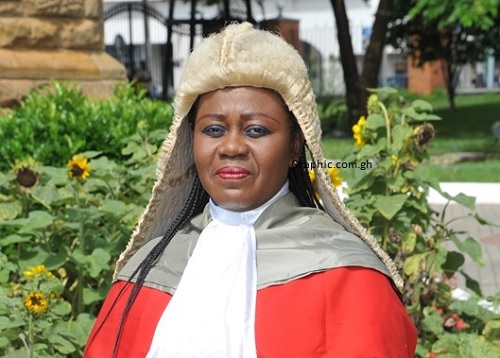
After two years in office, Justice Gertrude Araba Torkornoo has become the first Chief Justice to be removed from office since Ghana’s return to democratic rule in 1992.
She is also the second Chief Justice to be removed from office in the history of Ghana, with the first being Justice Sir Arku Korsah, who was sacked by Ghana’s first leader, President Kwame Nkrumah, in 1963.
Justice Torkornoo, appointed Chief Justice in June 2023, was removed from office on Monday September 1, 2025 by President John Dramani Mahama, acting on a recommendation of a constitutional committee formed under Article 146 of the 1992 Constitution to probe three petitions accusing her of misconduct in office.
Under Article 146(9) of the 1992 Constitution, the President is bound by law to act in accordance with the recommendation.
The said constitutional provision stipulates that: “The President shall, in each case, act in accordance with the recommendations of the committee.”
Immediate effect
A statement issued yesterday by the Minister of Government Communications, Felix Kwakye Ofosu, said the removal of Justice Torkornoo took immediate effect.
“President John Dramani Mahama has, in accordance with Article 146(9) of the 1992 Constitution, removed the Chief Justice, Her Ladyship Justice Gertrude Araba Esaaba Sackey Torkonoo, from office with immediate effect.
“This follows receipt of the report of the Committee constituted under Article 146(6) to inquire into a petition submitted by a Ghanaian citizen, Daniel Ofori.
“After considering the petition and the evidence, the Committee found that the grounds of stated misbehaviour under Article 146(1) had been established and recommended her removal from office,” the statement added.
Supreme Court judge
Meanwhile, two Constitutional Law experts and lecturers have shared varied views on whether or not Justice Torkornoo can still assume her role as a Justice of the Supreme Court despite her removal as Chief Justice.
Under the 1992 Constitution, the Chief Justice is an administrative position, with the occupant also a member of the Supreme Court panel.
While Professor Kwadwo Appiagyei-Tuah of the University of Ghana School of Law is of the view that the former Chief Justice can go back to her position as a Justice of the Supreme Court,
Albert Quashigah of the University of Professional Studies, Accra (UPSA) Law School, argues that it is not possible.
Prof. Appiagyei-Tuah told the Daily Graphic that Justice Torkornoo was not removed as a Justice of the Supreme Court and, therefore, she was free to continue performing her duties as a judge.
“The case was not against her as a Justice of the Supreme Court, but as a Chief Justice. The procedure for removing a Chief Justice is slightly different from the removal of a Justice of the Supreme Court.”
“As it stands now, Justice Torkornoo can go back and assume her position as a Justice of the Supreme Court,” Prof. Appiagyei-Tuah stated.
However, Mr Quashigah shared a different view, stressing that although it might seem possible for Justice Torkornoo to assume her position as Justice of the Supreme Court, the fact that she had been found not fit to hold the highest judicial office meant she should not be allowed to continue to be on the bench.
“The question is the optics.
The judiciary must exude confidence, so if she has been removed for stated misbehaviour, that tag follows her, making her unfit for the bench,” he stated.
Report
Earlier yesterday, the five-member committee presented its report on the first petition to President Mahama at the Jubilee House.
The Chairman of the committee established under Article 146(6) of the 1992 Constitution, Justice Gabriel Scott Pwamang, presented a sealed envelope containing its findings and recommendations, culminating in a months-long, confidential investigation process.
Other members of the committee present at the meeting were former Auditor-General Daniel Yaw Domelevo, Major Flora Bazaanura Dalugo of the Ghana Armed Forces (GAF), and Professor James Sefah Dzisah, an Associate Professor at the University of Ghana.
The chairman outlined a rigorous and extensive procedure.
The committee, which began its work on May 15, 2025, examined the first petition filed by Daniel Ofori, which involved 13 witnesses testifying for the petitioner, 12 witnesses, including experts, called by the Chief Justice in her defence, and the Chief Justice herself taking the stand to testify and be cross-examined.
Justice Pwamang said the committee examined a trove of evidence totalling approximately 10,000 pages of documentary exhibits, and legal teams of four lawyers each, representing both the petitioner and the Chief Justice.
With the committee's commitment to its constitutional mandate, the Chairman stated that it conducted its work "in camera" (privately) and refrained from public commentary, in spite of what he described as "blatant false statements" circulating about their work.
The assessment was described as a "critical and dispassionate examination, without fear or favour."
The contents of the envelope remain a closely guarded secret, known only to the committee and now the President.
Two more petitions also seeking the impeachment of the Chief Justice are yet to be determined by the committee, with one adjourned and the other still pending for hearing.
Lawsuits
Although the inquiry into the three petitions seeking the removal of Justice Torkornoo was held in camera as stipulated by Article 146(8) of the Constitution, issues surrounding it became a spectacle in the law courts and in the courts of public opinion.
Four constitutional applications for interlocutory injunction were filed against the suspension of Justice Torkornoo and the impeachment process.
All four applications for interlocutory injunction, including the recent one by the Chief Justice herself, were dismissed by the Supreme Court.
Justice Torkornoo described the process as a “flagrant violation of the rules of natural justice and fair trial as guaranteed by the Constitution”.
Apart from the cases at the Supreme Court, Justice Torkornoo further filed a certiorari application at the High Court, asking the court to quash some decisions of the committee of inquiry on the basis that they were arbitrary and against the rules of natural justice.
The court, however, dismissed the application, ruling it was not different from the case dismissed by the Supreme Court, and that it had no jurisdiction to interpret the Constitution or review a decision of the highest court of the land.
The Chief Justice also filed an application for the enforcement of her human rights at the ECOWAS Community Court of Justice on the same issue. The case is still pending at the sub-regional court.
Background
On April 22, the Spokesperson to the President and Minister of Government Communications announced that President Mahama had suspended Justice Torkornoo.
The suspension of the Chief Justice by President Mahama, under Article 146 (10) of the Constitution, followed the determination of a prima facie case by the President, in consultation with the Council of State, and the subsequent establishment of a five-member committee to inquire into the petitions, in accordance with Article 146 (6) of the 1992 Constitution.
