
New VAT reforms deliver early relief - Shopping malls slash prices by 1.9%
Major shopping malls across the country have reduced their prices by up to 1.9 per cent to offer some relief to consumers.
It follows the implementation of the new Value Added Tax (VAT) Act, 2025 (Act 1151), which took effect on January 1 this year.
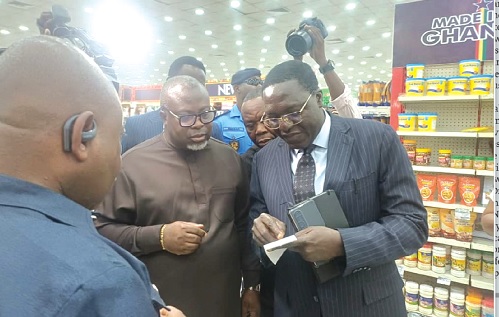
The price reductions were confirmed during a working visit by a delegation from the Ghana Revenue Authority (GRA), led by the acting Commissioner-General, Anthony Kwasi Sarpong, and the acting Commissioner of the Domestic Tax Division, Dr Martin Kolbil Yamborigya, to several major shopping malls in Accra, where they engaged operators and customers on the early impact of the new tax reforms on pricing and compliance.
The delegation also made purchases at the malls visited to verify that the VAT reforms had been properly configured on invoices and that consumers were genuinely benefiting from the changes.
The shopping malls visited — Palace, Melcom Ghana, Orca Deco Ghana, United Commercial Trading (UCT), and Palace Home Décor — are all located along Spintex Road in Accra, with branches spread across the country.
Mr Sarpong stated that the VAT reforms offered GH¢6.5 billion in the pockets of Ghanaians as the authority assessed the early implementation of the new regime.
He said the feedback from shoppers validated earlier projections by the Minister of Finance, Dr Cassiel Ato Forson, on the economic impact of the policy.
“What we are seeing this morning affirms the minister’s statement that these reforms are returning over GH¢6.5 billion into the pockets of Ghanaians,” he said.
He said the visit was aimed at witnessing firsthand how businesses were applying the revised VAT structure following the recent reforms.
He explained that the changes were comprehensive, which included a reduction in the VAT rate, the abolition of the COVID levy, the removal of the coupling mechanism, and an upward review of the threshold for small businesses.
“We are satisfied that all the shops we visited have configured their systems and are applying the new VAT rates and so we can confirm that the reforms were already reflecting positively at the point of sale,” he said.
Background
The price adjustments come on the back of wide-ranging reforms under the new VAT regime.
The reforms include the abolition of the COVID-19 Health Recovery Levy, a reduction of the effective VAT rate from 26 per cent to 20 per cent to ease the tax burden on households and businesses, while the VAT Flat Rate Scheme (VFRS) has been abolished in favour of a unified and more transparent VAT structure.
The VAT registration threshold for goods-dealing businesses has been increased from GH¢200,000 to GH¢750,000. In addition, the National Health Insurance Levy (NHIL) and the GETFund levy have been re-coupled, enabling businesses to claim input tax credits, with both levies now recognised as allowable input tax deductions.
The Commissioner-General stated that engagements with consumers also confirmed growing public appreciation of the reforms, particularly the reduction in prices.
He urged business owners to embrace voluntary compliance by properly charging VAT, configuring their systems, and issuing VAT invoices as required by law.
Consumers, he said, also had a responsibility to demand VAT invoices when making purchases.
“When businesses act responsibly and consumers demand their VAT invoices, together we can generate the revenue needed for national development,” Mr Sarpong stressed.
The Commissioner-General explained that the reforms aligned with the President’s vision of making 2026 a year of growth, job creation and transformation, stressing that sustainable development depended on strong domestic revenue mobilisation.
Evidence of compliance
For his part, Dr Yamborigya stated that field assessments conducted by the monitoring team had confirmed strong compliance with the new VAT regime among shops visited.
He explained that officials carried out test purchases and carefully examined receipts, focusing on pricing and tax line items.
“One notable outcome was the complete removal of the one per cent COVID-19 levy from invoices.
“In the test purchases that we did, we looked at the line items and one thing that was obviously missing was the COVID levy, which has been completely abolished,” Dr Yamborigya said.
He said that the revised structure applied the NHIL at 2.5 per cent, the GETFund levy at 2.5 per cent and VAT at 15 per cent, all calculated on the same base.
Dr Yamborigya said the removal of the cascading effect — where levies were previously applied before VAT—had led to a reduction in the final price paid by consumers.
“That cascading effect had been removed, and it effectively reduced the price of the item,” he added.
GRA urges vigilance
Dr Yamborigya said receipts issued to customers provided clear evidence that the reforms were delivering savings.
He stated that feedback from consumers confirmed a reduction in prices compared with the period before the implementation of the new law.
“It was confirmed by a customer that there was a saving of about 1.9 per cent as a result of the new VAT Act, and we have a receipt to show that,” he said.
He added that businesses had expressed satisfaction with the simplified tax system, while consumers welcomed the lower prices.
Dr Yamborigya also encouraged Ghanaians to demand VAT invoices whenever they made purchases to ensure accountability.
“It is our responsibility as consumers to always demand a VAT invoice and check it to be sure we are not being overcharged,” he said.
System reconfiguration
The Head of Accounting at Orca Deco Ghana, Nestor Amagah, said the company had used the brief closure at the end of December to reconfigure its systems to reflect the new VAT structure.
“As far as the tax is concerned, so far there has been no complaint, and we can confirm a price reduction of about 1.9 per cent, which puts more money in the pockets of consumers,” he said.
Satisfaction
A buyer at Palace Home Décor, Frances Atakpa, who interacted with the delegation, expressed satisfaction with the new VAT reforms.
“At least that 1.9 per cent, I can save it and use on fuel or use it for something else, and so it goes a long way to help us as consumers.
We are grateful to the government,” she said.
