
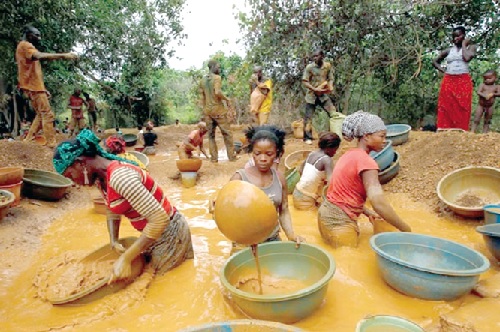
Galamsey: A political or a public policy problem?
Last year, in the lead-up to the election, galamsey emerged as an issue.
The Democracy Hub held a three-day protest to draw attention to it.
The Catholic Archdiocese of Accra organised an environmental prayer walk to highlight the dangers of galamsey.
The timing of these protests was called into question by sympathisers of the ruling party who felt they were politically motivated.
Sometimes, though, it takes an impending election to get the attention of elected officials.
Galamsey is still ongoing as per media reports.
The various news analysis shows continue to bring experts, government officials and political party communicators to address the issue.
On September 21, 2025, there was a protest to draw attention once again to it.
The government is under pressure to address the issue, especially given some of its own assertions during the 2024 presidential and parliamentary elections.
Context
In an October 2022 Daily Graphic piece, I pointed out a) the economic incentive structure that encourages it; b) various policy attempts by different governments to deal with it over the years; and c) the opposition strategy of making incumbent governments politically vulnerable to the issue.
In September 2024, drawing on data from Afrobarometer Round 7 (2017) and the CDD-Ghana 2020 pre-election survey, I summed the public’s attitudes on the issue in a Daily Graphic piece as follows: a) citizens should not engage in ‘galamsey’; b) economic challenges notwithstanding, citizens should still not engage in ‘galamsey’; c) government should be responsible for providing alternative livelihoods for persons engaged in ‘galamsey’ and d) approval of government’s efforts in dealing with ‘galamsey’ has declined.
In an October 2024 Daily Graphic piece, I discussed the New Patriotic Party (NPP) and National Democratic Congress (NDC) proposals as captured in their respective manifestos to fight galamsey, should they be elected.
Those proposals fell under three main categories: a) greater regulatory oversight; b) improved practices for artisanal and small-scale mining; and c) government support.
Reiterating all the above is simply to make the point that public attitudes are clear on galamsey and our two main political parties have proposed ways in which the problem can be solved.
So, the question is, why does it continue to remain a seemingly intractable problem?
The public policy problem
Here is how I see the public policy problem of galamsey.
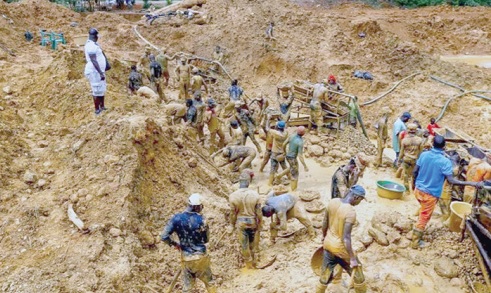
Some illegal miners busily mining
First, Ghana is a country well-endowed with natural resources.
The State has a keen interest in extracting maximum value from these natural resources, such as gold, to help address the country’s development needs.
To do this, the State has set up elaborate institutional arrangements with rules that govern the entire value chain, from extraction to earning rents.
Second, some people have decided to bypass the State’s institutional arrangements and rules to illegally engage in extraction activities in ways that serve narrow, selfish interests but impose an external cost on the rest of society.
Third, it appears the State is unable to fully exercise its regulatory and oversight powers to deal with this problem, even as it recognises the dangers it poses to society.
The politics problem
In a multiparty democracy with regular elections, an unfortunate reality is that public policy problems become an electoral asset or liability.
It just depends on where a political party sits during the election year.
For example, in the lead-up to the 2024 elections, as an opposition party, the public policy problem of galamsey, in my opinion, was weaponised as an electoral asset by the NDC, with promises and proposals to deal decisively with the issue if elected.
Once weaponised, it became an electoral liability for the incumbent NPP, as their government was portrayed as both complicit in the activity and incapable of solving it.
With a turnover election, I observe that it is the turn of the NPP to weaponise the issue as an electoral asset while making it a liability for the NDC.
Part of the weaponisation is the constant argument over which political party has done a yeoman’s job of fighting galamsey or under whose watch Ghana’s rivers have been more polluted.
Reconciling policy and politics
There needs to be a point of reconciliation.
To the credit of these two main political parties, there is a political consensus that galamsey is a public policy problem in need of decisive solutions.
Where there is a lack of consensus, in my opinion, is treating the issue as a positive sum game – no winners or losers, just two political parties interested in solving the problem and not concerned about any electoral dividends (positive or negative) that may come with it.
If our two political parties can reach a consensus and build on it, I believe the country can make significant strides in the fight against galamsey.
The question is, will they get there?
The writer is the Project Director, Democracy Project.
