
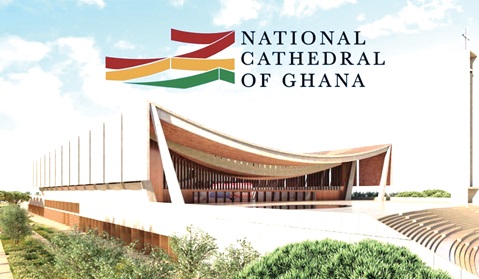
Two of Ghana’s most prominent pastors, Archbishop Nicholas Duncan-Williams and Dr Mensa Otabil, have recently pontificated on controversial political issues.
Archbishop Duncan-Williams claims the supreme importance of prayer to combat illegal mining (galamsey). Dr Otabil believes that the National Cathedral should immediately be built as an ambitious project to the glory of God.
Moral and prophetic duty or partisan bias?
When is it appropriate for prominent pastors publicly to address socio-political issues like illegal mining (galamsey) and national infrastructure projects, including the National Cathedral?
It is fitting when these issues directly impact public morality, human dignity, and environmental stewardship; it is not when they serve – or may be seen to serve – partisan political agendas.
Clergy hold a civic and moral obligation to give voice to the suffering or the marginalised affected by poor public policy.
Pastors should speak out when national resources, public health, and livelihoods are severely endangered, such as the severe destruction of water bodies and farmlands caused by galamsey.
Addressing state projects like the National Cathedral is appropriate when leaders call for financial transparency, institutional integrity, and the ethical use of public funds.
Galamsey
Archbishop Nicholas Duncan-Williams, General Overseer of Action Chapel International, has issued a strong warning and made a public plea regarding the devastating impact of galamsey on Ghana’s environment and long-term survival.
During a recent church service, he focused heavily on the galamsey crisis, asserting that the country was currently operating under a ‘veil and a spell of money, politics, and manipulations of fetish and demonic powers’ that obscured the hidden backing of the galamsey menace.
The archbishop urged Ghanaians to pray aggressively for supernatural restoration and healing of Ghana’s highly polluted water bodies, forests, and degraded farmlands. He stated:
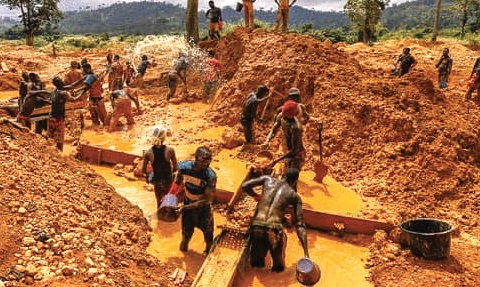
Some illegal miners at a galamsey site
‘We are praying concerning the healing of our water bodies and the land, that our water bodies and our land will not be poisoned through this galamsey’.
He also raised the alarm regarding the agricultural consequences of galamsey.
Toxicity of the water supply translates directly into the poisoning of the soil, leading to barren soil, chemical contamination of crops, and food shortages. He urged prayers specifically for Ghana's Minister of Agriculture and the sector as a whole to avert severe national food shortages.
Warning
His public galamsey warning sparked an immediate, strong backlash from Ghanaians across social media platforms.
Many stated that prayer on its own was not enough.
It must be bolstered by physical enforcement to prevent lawbreaking, corruption and political complicity.
These issues cannot be solved merely through spiritual intervention.
The Apostolic Fathers of Ghana (a group of prominent church leaders led by Duncan-Williams) has previously issued concrete calls demanding an immediate, temporary ban on small-scale mining.
Why, it was asked, has this approach changed: seemingly shifting from demanding structural state crackdowns to solely urging spiritual intercession?
Netizens speculated that the archbishop was indicating pro-Mahama/NDC bias by apparently letting the present government off the hook over galamsey by relying on God alone, through prayer, to rectify things.
Archbishop Nicholas Duncan-Williams tasked the previous Akufo-Addo government to deal with galamsey – without overt reliance on God’s assistance.
Dr Mensa Otabil recently made headlines by explicitly defending the controversial National Cathedral project.
He claimed that Ghanaian Christians were using ‘their own mouths’ to ‘tear down’ the cathedral, suggesting that ‘small-minded’ partisan politics’ prevented Ghana from building a massive, ambitious project to the glory of God.
Dr Otabil’s stance in relation to the National Cathedral has changed. In 2017, when the Akufo-Addo government initially proposed the National Cathedral, Dr Otabil was appointed to its 13-member Board of Trustees.
However, he did not actively serve.
The National Cathedral Secretariat later clarified that he declined to be formally registered as a director because he could not give the project the required time and attention.
In 2022, his name was officially removed from the list of trustees following public scrutiny led by opposition members of parliament.
For much of the peak controversy surrounding the stalled $97 million project – which faced intense criticism over state funding, lack of transparency, and procurement issues – Dr Otabil remained largely silent, distant from the project’s execution.
Pastors and politics
Given that Ghana is constitutionally a secular democracy, the question is: When is it appropriate for prominent pastors publicly to contribute to discussion of controversial political issues?
Pastors’ political involvement is inappropriate when they use the pulpit to endorse specific political parties or candidates, as it transforms sacred spaces into partisan battlegrounds.
Public trust reduces when religious leaders appear to be siding with one party or another as it is seen as compromising their independence and objectivity.
Their direct political engagement should focus on societal values and biblical stewardship rather than seeming to defend or attack particular governments for political gain.
The writer is Emeritus Professor of Politics, London Metropolitan University, UK
