
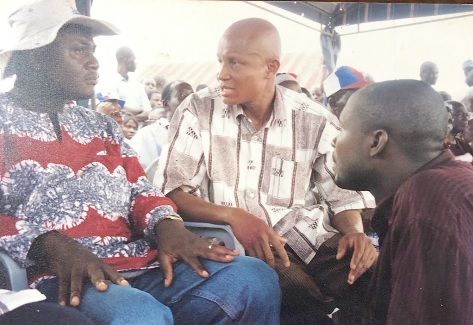
The party needs its best: A clarion call for Dr Mustapha Abdul-Hamid - Why the NPP’s First National Vice Chairmanship must go to one of its finest sons
The Party Needs Its Best: A Clarion Call for Dr. Mustapha Abdul-Hamid | Why the NPP’s First National Vice Chairmanship Must Go to One of Its Finest Sons.
There are moments in the life of every political party when the ordinary calculus of internal elections must give way to something higher, something more urgent, something that the long arc of history demands.
Ghana’s New Patriotic Party stands at precisely such a crossroads today.
Bruised by a punishing electoral defeat in December 2024, stripped of incumbency, and facing the hard interior work of rebuilding, reorganisation, and reimagination, the NPP cannot afford to fill its leadership positions with sentiment alone, or with the comfortable currency of patronage and rotation.
It needs its best. And among its best, one name rises with a consistency that no honest observer of Ghanaian politics can dismiss: Dr. Mustapha Abdul-Hamid.
This is not a coronation.
This is a call. A clarion call from the youth, from the rank and file, from the grassroots men and women.
It is a call that says: we have seen enough of mediocrity dressed up as loyalty, and we want a leader who has actually bled for this party over thirty years of frontline service.
Dr. Abdul-Hamid must contest for the position of First National Vice Chairman of the NPP. And he must win it.
The Weight of a Record That Speaks for Itself:
Let us deal plainly with the record, because in politics, records are the only biography that matters.
Dr. Mustapha Abdul-Hamid served as the NPP’s first National Youth Organiser, a pioneer in the most literal sense of the word, building youth structures at a time when the architecture of youth mobilisation within the party was still being drawn from scratch.
To be first at anything in a political party of the NPP’s complexity is not a footnote; it is a founding act.
He understood, before many did, that the battle for Ghanaian democracy would be fought on the streets, in the polytechnic common rooms, in the JCRs of our universities and higher institutes of learning, and in the dusty lorry parks where young people gather with grievances and dreams in equal measure.
He then served as a spokesperson for a presidential candidate longer than any other individual in the recorded history of Ghana’s competitive multiparty politics.
That is not a ceremonial distinction. It means that for years, whenever the NPP’s message had to be precise, had to be credible, had to cut through the noise of propaganda and counter-narrative, Dr. Abdul-Hamid was the man standing at the microphone.
The spokesperson role is, in many respects, the most intellectually demanding position a political operative can occupy.
You are the party’s mind and mouth simultaneously.
You must understand policy deeply enough to defend it, politics sharply enough to attack it, and communication well enough to translate both into language that moves people. He did all of this, repeatedly, at the highest level.
He served as Minister for Information, a ministry that sits at the nerve centre of any government’s relationship with its citizenry.
He served as Minister for Zongo and Inner-City Development, bringing the marginalised communities that so often feel like afterthoughts of state power into the mainstream of development planning.
He served as Chief Executive Officer of the National Petroleum Authority, overseeing regulatory governance in one of the most critical sectors of the Ghanaian economy.
And through it all, he maintained an academic life, carrying the intellectual rigour of a university professorship into every public role he occupied.
Thirty years. Not thirty years of just being around.
Thirty years of frontline work, civic leadership, and political activism.
There are people in this party who have never addressed a town hall meeting asking for the same positions that Dr. Abdul-Hamid is being urged to contest.
The contrast should disturb every serious NPP member.
History’s Lesson: When Parties Turn to Their Intellectuals
History is generous with examples of what happens when battered political parties reach for their best minds at moments of crisis, and what happens when they do not.
When the British Labour Party suffered its devastating defeat in 1983, reduced to its worst electoral performance since 1935, it was the gradual assertion of intellectual and strategic renewal, led eventually by Neil Kinnock and then refined by figures who combined ideological depth with communicative power, that began the long road back to relevance.
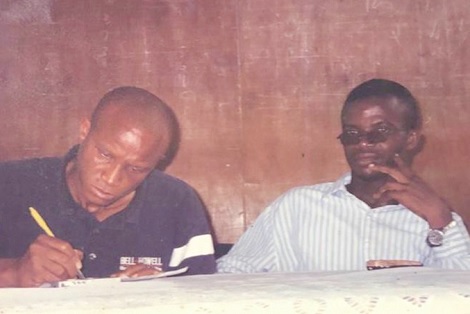
Mustapha Abdul-Hamid at a TESCON programme in 2003. With him is Stephen Amoah, MP for Nhyieso and then Ashanti Regional Coordinator of TESCON
The lesson from that Labour recovery, culminating in Tony Blair’s 1997 landslide, was not simply about changing policy positions. It was about reclaiming the party’s credibility as a serious governing force, capable of attracting the trust of sceptical citizens.
That credibility was rebuilt by people who could think and articulate, not merely mobilise and manipulate.
When the French Socialist Party collapsed after its humiliation in the 2002 presidential elections, where Jean-Marie Le Pen finished second ahead of the Socialist candidate Lionel Jospin, triggering national shock, it was the painstaking internal renewal driven by intellectually serious figures that allowed the party to remain a credible political force and eventually return to power.
Parties that survive electoral catastrophe are almost always parties that took the work of internal reorganisation seriously, that placed intellectual weight at the top of their structures.
In the United States, after the Republican Party’s repeated failures in the 1990s to arrest Bill Clinton’s political dominance, it was the combination of strategic intellectual leadership and grassroots organisational discipline, exemplified by figures like Newt Gingrich with his Contract with America, that repositioned the party and led to a sweeping congressional victory in 1994.
One may agree or disagree with Gingrich’s politics, but the point stands: when a party is down, ideas and the ability to prosecute those ideas publicly are the most powerful tools of recovery.
Closer to the African continent, the African National Congress, for all its subsequent difficulties, drew enormous early strength from the intellectual depth of its leadership.
Oliver Tambo, Walter Sisulu, Nelson Mandela, they were not simply activists.
They were thinkers, legal minds, orators, and strategists whose intellectual authority gave the movement a coherence that no amount of state repression could fully dissolve.
The ANC’s moral and political credibility was, in substantial measure, a product of the quality of the minds it placed at the front.
Ghana’s own political history offers the same instruction.
The early CPP drew enormous energy from Kwame Nkrumah’s intellectual formation, his years of study and political apprenticeship abroad feeding directly into the sharpness of his domestic political operation.
The UP tradition, from which the NPP draws its lineage, was consistently energised by the presence of formidable legal and intellectual minds who gave the tradition its argumentative spine. J.B. Danquah was not merely a political organiser; he was a scholar, a lawyer, a thinker of continental reputation.
That intellectual seriousness was never incidental to the tradition’s survival. It was its foundation.
The NPP in 2026, going into 2028, needs to absorb this lesson with urgency. A party in opposition, preparing for a journey back to power, cannot afford to hollow out its internal leadership by placing organisational lightweights in positions that require weight.
What the NPP Actually Needs Right Now
The NPP’s challenge between now and 2028 is not merely logistical. It is deeply political, deeply communicative, and deeply intellectual.
The party must explain to Ghanaians, in honest and compelling terms, what went wrong in its last term of government, what it will do differently, and why it remains the most capable vehicle for the country’s prosperity.
That is a task that requires leaders who can speak to policy, engage the media without flinching, address the intelligentsia without condescension, and talk to the grassroots without pretension.
It requires leaders who understand governance not as an abstract concept but as a practice they have lived through, from the community water project to the regulatory boardroom to the ministerial office.
Dr. Abdul-Hamid meets every single one of those requirements. His experience as Information Minister means he understands how governments communicate, and how they fail to.
His time at the NPA means he understands the mechanics of economic governance in a resource-dependent state. His academic life means he brings an analytical framework to political questions that purely career-politician types simply cannot replicate.
His thirty years on the frontline means he has the credibility with the grassroots that no amount of last-minute campaigning can manufacture.
The First National Vice Chairmanship of the NPP is not a retirement post.
It is a working position of strategic consequence.
Whoever occupies it will help shape the party’s reorganisation, its internal cohesion, its external messaging, and its electoral positioning going into 2028.
Putting a figure of Dr. Abdul-Hamid’s calibre in that role sends an immediate and powerful signal: that the NPP is serious, that it is learning, and that it intends to fight.
A Word to Dr Abdul-Hamid Himself
There are men who spend their lives serving institutions and then, at the moment the institution most needs them, step back into comfortable silence.
History does not remember those men well.
The record of political service is written not only by what you did when circumstances were favourable, but by what you were willing to do when the party was in the wilderness, when the cameras were elsewhere, and when the reward was not a ministerial saloon but the harder, less glamorous work of rebuilding.
Dr. Abdul-Hamid has given thirty years to this party and to this country.
He could be forgiven for thinking that he has earned his rest. But a man of his intelligence knows that parties like the NPP do not rebuild themselves.
They rebuild because the right people, at the right moment, accept the call to service with their eyes open.
The youth of this party are watching.
The rank and file, the branch executives in Wa East and Asunafo North and Keta and Ablekuma Central, the young men and women who have given their energy and their passion to the NPP not because of what they received but because of what they believed, they are watching.
They are not asking Dr. Abdul-Hamid to take an easy road.
They are asking him to take a necessary one.
Serve. Contest. Win. Lead.
The NPP needs its best at the front. And Dr. Mustapha Abdul-Hamid is, by any serious reckoning, among the very best this party has ever produced.
The call has gone out. History is listening for the answer.
By: Mustapha Hameed
Aboabo, Kumasi.
