
How Ga became the home of boxing
Boxing was organised as a sport in Accra in the early twentieth century, influenced by both Western boxing and the indigenous Ga sport, asafo atwele.
The Ga state rose to prominence in the sixteenth century, controlling Akwamu, until it was defeated in wars from 1677 to 1681, leading to its decline.
The royal family fled, while others settled in Little Accra. Akwamu’s dominance ended with the Accra-Akyem-Akwapim alliance’s victory in 1730, allowing the Ga state to be reformed in Accra, comprising two towns: James Town and Ussher Town, each subdivided into several quarters.
Each Ga town sought settlers, utilizing asafo companies composed of all able-bodied individuals, including slaves, for defense.
As warfare ceased to be a wealth source in colonial Gold Coast, chiefs resorted to land sales, causing rifts among them.
Notably, James Town declared independence from Ussher Town, leading to conflicts over land and chief destoolment in the 1880s and 1920s.
The political turmoil in Accra during the 1920s and 1930s prompted the need for asafo companies to engage their fighters in organized competitions called asafo atwele, with the rallying cry ‘odododi-odioo.’
Contests, supervised by asafo captains (Ga: asafoatsemei), were organised in age groups between two towns, involving a unique cultural interaction focused on boxing.
On Sundays, participants engaged in sea bathing, followed by a symbolic challenge ritual where a challenger would shout “odododiodioo!” and receive the response “oo aieee!” indicating acceptance.
The fighting commenced among young boys starting at age 12, with participants from Ussher Fort and James Town aligning on opposing sides.
Participants would then march to Bukom, the venue for a more formalised tournament that included various age groups from children to older men.
The matches emphasised an exchange of blows and kicks, with victory being celebrated in style, energized by large crowds of women and girls cheering for their favored fighters.
The Ga invented the fighting style and the origins of asafo atwele which involved the use of the hands and the feet in an exchange of blows and kicks.
Those who fought specialised in either kla or klamo, which was an exchange of hand-blows in lightening fashion, or ntia (kicking) and there were contests that just involved the use of the legs.
In the 1930s, Accra faced political conflicts involving the asafo companies, notably between the Manbii Party, led by Kojo Thompson, and the Ratepayers Association, headed by Dr. F. W. Nanka-Bruce. The colonial government banned the asafo companies as armed factions around 1935, prompting a shift of their skills towards boxing.
British officer Maxwell Lawford established boxing clubs in Osu and Bukom, effectively transforming asafo atwele into regulated boxing venues.
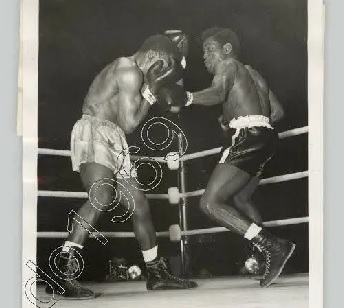
Experts from Asafo Atwele seamlessly transitioned into boxing, with Roy Ankrah, or “the Black Flash,” leading the way as the first major champion by winning the British Empire Featherweight title in 1951.
This initiated a legacy of Ga lightweight champions such as Floyd Robertson and Azumah Nelson.
Notable boxing schools like Maconi and Sparta emerged, operating gyms in Usher Town, Palladium, and Swalaba, with the Akotoku Academy, founded by Jonas Thompson at the Methodist school in Adabraka, being the most prominent.
