
The United States Embassy in Accra has completed a three-city girls’ football coaching initiative with ambitions to build a broader development pathway — but the shape and scale of the next phase will depend on feedback from coaches and identified grassroots needs.
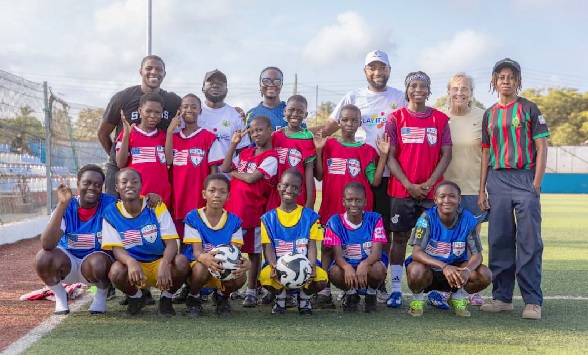
The 10-day Sports Envoy programme, staged across Tamale, Kumasi and Accra, trained about 60 coaches and concluded at the McDan La Park in Accra on Wednesday, September 16, where 96 female student-athletes participated in the final session.
Led by US Sports Envoys Kofi Sarkodie and Amy Griffin, the initiative focused less on producing short-term results and more on strengthening the people who shape young players: coaches.
Using a train-the-trainer model, the programme equipped coaches with methods they can replicate with current and future teams, extending its potential impact well beyond the participants directly involved.
Sessions covered technical and tactical development, injury prevention, warm-up routines, communication, discipline, teamwork and the creation of positive team cultures.
For the Embassy, that multiplier effect is central to the initiative.
The Culture and Education Attaché at the US Embassy, Dornya Donyá Eldridge, said about 15 to 16 coaches were trained in each city, with the programme deliberately structured to create longer-term value rather than end with the departure of the sports envoys.
“We will gather information from coaches about their needs and desired follow-on training,” Eldridge said.
That feedback, she explained, will help determine the design of any subsequent programme instead of simply reproducing the same format.
It is a significant consideration for an initiative operating in an area with considerable development potential.
Girls’ football continues to grow globally, both as a competitive sport and as a platform for education, leadership, commercial investment and social development. Building sustainable structures beneath the elite level, however, depends heavily on the quality of coaching, player welfare and the environment in which young girls enter and remain in the sport.
Sarkodie, a former Major League Soccer player born in the United States to Ghanaian parents, brought both professional experience and a strong development focus to the programme.
After making more than 130 appearances in MLS, he has become increasingly involved in youth and community development and used his sessions in Ghana to demonstrate how relatively simple football drills can deliver broader lessons.
His coaching emphasised technical instruction alongside confidence, communication and relationship-building.
“Those skills outside the pitch can develop and provide a future for the girls, whether it’s in football or in different professions, so they can be leaders in their community,” Sarkodie said.
He also encouraged coaches to build stronger relationships with their players and with one another, stressing football’s potential to create connection and belonging as much as sporting excellence.
Griffin brought a different layer of authority to the programme. A member of the United States team that won the inaugural FIFA Women’s World Cup in 1991 and now coach of the US Deaf national team, she placed particular emphasis on player welfare and retention.
“Coaches must create a safe environment for girls to make mistakes,” Griffin said, urging coaches to “inspire girls to enjoy soccer and improve teamwork”.
Beyond her caution on technique, Griffin highlighted concerns that 50 per cent of girls drop out of sport between the ages of 14 and 17 when they do not feel adequately supported, making the coaching environment critical to whether young players remain involved.
Coaches, she argued, must create communities in which girls feel confident, valued and able to develop leadership skills alongside their sporting abilities.
That philosophy ran through the wider programme. By moving through Tamale, Kumasi and Accra, the initiative also broadened its geographical reach beyond the capital, exposing coaches and young players in different parts of the country to the same development framework.
The Embassy says it will use feedback from participating coaches to identify priorities for future training — an approach that could determine whether the three-city project remains a successful one-off intervention or develops into a more durable platform for girls’ football, leadership and community development.
The initiative forms part of the US Embassy’s broader use of sport to promote mentorship, skill development, leadership and people-to-people engagement.
