


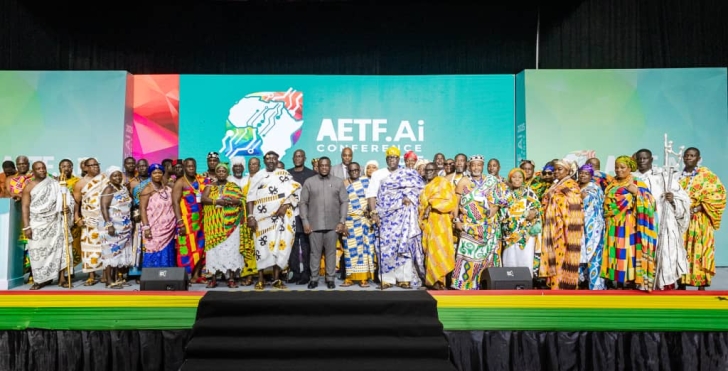
“AI must work for Africa, not on Africa” — Leaders rally at maiden Africa AI Conference
Ghana has hosted the maiden edition of the Africa Artificial Intelligence (AI) Conference, a gathering that brought together government leaders, policymakers, innovators, and scholars to define the continent’s role in the rapidly evolving global AI landscape.
The event, organised by the Africa Education Trust Fund (AETF) at the Accra International Conference Centre on November 5, 2025, was held under the theme “AI for Africa: Unlocking Opportunities for Education, Innovation, and Sustainable Development.” It featured exhibitions showcasing AI-driven innovations in education, health, agriculture, and governance, highlighting Africa’s growing engagement with digital technologies.
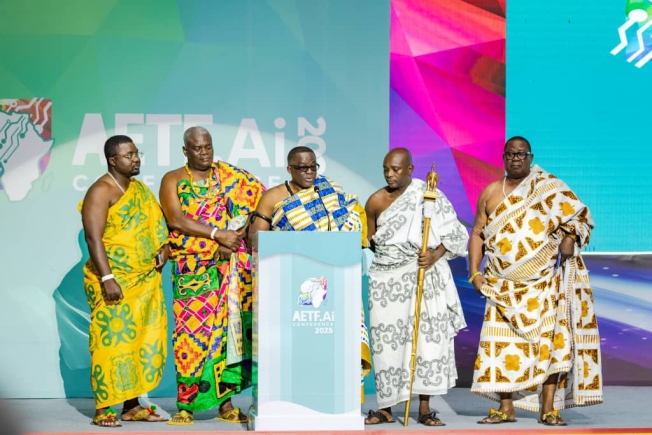
Speaking on behalf of President John Dramani Mahama, the Chief of Staff, Julius Debrah urged African nations to seize the AI opportunity with strategic intent. He said the technology represented a transformative tool for national development. “The theme ‘AI for Africa: Unlocking Opportunities for Education, Innovation, and Sustainable Development’ is both timely and imperative,” he said. “Countries that harness AI are already seeing gains in learning outcomes, health system efficiency, agricultural productivity, and climate resilience.”
Mr Debrah described AI as a driving force in reshaping economies and daily life. “Artificial Intelligence has caught everyone's attention because of its speed of enablement and disruption, embedding itself in our daily lives. It is shaping our classrooms, our farms, our hospitals, and our economies,” he noted. Citing examples from across the continent, he said “in Mali, AI tools are translating books into local languages, making learning more inclusive,” while “in Kenya, AI is bridging the gap for deaf students through sign language translation technologies.”
He reaffirmed Ghana’s commitment to digital transformation through the development of a National AI Strategy and the ‘One Million Coders’ initiative, aimed at equipping young people with digital skills. “The full potential of AI will not be realised with passive efforts,” he cautioned, urging African governments to invest in education reform, data infrastructure, and inclusive technology policies. “The future of AI in Africa is not a question of possibility but a question of purpose. Let us unlock the full potential of AI for every child in every classroom, for every farmer in every field, for every patient in every clinic,” he concluded.
The Chairman of the Africa Education Trust Fund, Dr Ekwow Spio-Garbrah, described the emergence of AI as “a new frontier — one Africa cannot afford to miss.” He warned that the continent risked being sidelined if it did not act decisively. “If Africa fails to act swiftly, our voices will be absent from the future,” he said. Dr Spio-Garbrah urged governments to prioritise small, practical projects that deliver tangible results. “It is wiser to start small — with clear, results-driven initiatives — than to chase grand but distant projects.”
He lauded Ghana’s $50 million Innovation Fund as “a promising step,” and announced AETF’s intention to expand on such models to build “a multi-billion-dollar platform for Africa’s digital transformation.” He further challenged African leaders to “reshape the narrative — from a continent of limitation to one of limitless potential. Africa is not just a user of technology; we are the next frontier of innovation.”
Chairing the event, the Ga Mantse, Nii Tackie Teiko Tsuru II, called for an approach to AI development rooted in African culture and values. “The future of AI in Africa is not about machines. It is about our people,” he said. “Artificial intelligence can transform how we learn, how we farm, how we heal, and how we govern, but only if it is filled with our values, our realities, and our people at its center. AI must work for Africa, and not merely on Africa.”
The Minister for Communications, Digital Technology, and Innovations, Samuel Nartey George, announced plans for an Emerging Technologies Bill to regulate AI, Blockchain, and quantum computing. “Our goal is not just digital transformation but a restoration of Africa’s technological sovereignty,” he said. “Once consultations and cabinet approvals are complete, the Emerging Technologies Bill will be laid before Parliament, hopefully next year.”
He added that Africa’s AI advancement must be “guided by ethics, inclusivity, and cultural identity,” while UNESCO’s Representative to Ghana, Mr Edmond Moukala, called on African countries to build AI ecosystems that empower local developers and researchers to create solutions tailored to Africa’s needs.
Other speakers, including Margins ID Group CEO Moses Baiden and mPedigree founder Bright Simons, echoed the need for political will, investment in digital education, and the promotion of young African innovators. Ghana’s Minister of Sports, Mr Kofi Adams, stressed that Africa must not remain a bystander in the global technological revolution.
The AETF AI Conference concluded with a unified message: Africa’s digital future must be defined by Africans, guided by ethics, and driven by education, innovation, and inclusion.