


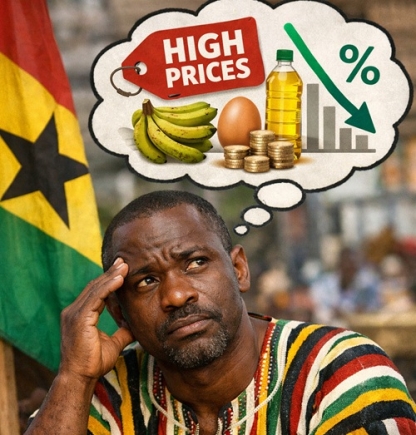
In the wake of Ghana's headline inflation rate falling sharply to 3.8 per cent, a figure heralded as a sign of returning macroeconomic stability, many citizens are left with a pressing, everyday question: if inflation is down, why do prices in the market still feel like they are going up?
Government Statistician, Dr. Alhassan Iddrisu, recently (January 28, 2026) provided a clear explanation to demystify this apparent contradiction, drawing on the technical definition of inflation itself. "When we say inflation," Dr. Iddrisu clarified, "inflation basically is the rate at which the general price level is what is rising, right, or, in fact, falling." The crucial distinction lies in the word 'rate'.
Anytime you see a positive inflation figure it means prices are rising - Government Statistician explains recent inflation numbers pic.twitter.com/txaeiGxSKd
— DailyGraphic GraphicOnline (@Graphicgh) January 28, 2026
Dr. Iddrisu used the data for December 2025 to illustrate his point. "So the 5.4%... means that the general price level in December 2025 actually increased... by what, 5.4% compared to what the previous year, which is December 2024." He stressed a vital technical detail: "any inflation figure that is positive... it means that prices are what rising, not falling." Therefore, the current 3.8 per cent inflation for January 2026 unequivocally means that, on average, prices in that month were 3.8 per cent higher than they were in January 2025.
The sensation of easing pressure, he explained, comes not from falling prices, but from a dramatic slowdown in the pace of their increase.
"If you compare the 5.4% to the previous year, which was December 2024 which was 23.8%... the rate has... really slowed. So there's a price increase in both cases, but the price increase in December 2025 is way much lower than the price increase in December 2024."
This national average, however, masks significant variations. While the overall rate has plummeted, the latest data (for January 2026) shows severe price increases for specific essentials like charcoal (53.7%) and green plantain (67.9%). Simultaneously, other items like garden eggs have seen prices collapse by 58.7%.
Furthermore, stark regional disparities mean a consumer in the North East Region faces an 11.2 per cent price increase, while one in the Savannah Region experiences a 2.6 per cent decrease (deflation).
Therefore, an individual's experience of prices "still going up" is entirely valid. They may be purchasing items within the basket that are still rising sharply, live in a region with above-average inflation, or simply feel the cumulative effect of years of previous high inflation, from which prices have not retreated.
The falling inflation rate signals the acceleration on the price pedal is easing, not that the vehicle is moving in reverse.
For prices to actually fall, the inflation rate would need to turn negative—a scenario called deflation, which Ghana is seeing only in isolated regional and product-level cases, not at the national level.