


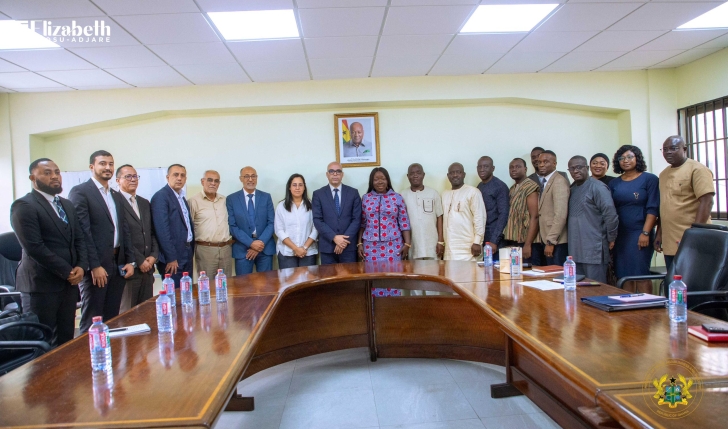
Ghana, Morocco deepen trade and agribusiness ties in strategic talks
The Minister for Trade, Agribusiness and Industry, Elizabeth Ofosu-Adjare, has held talks with a visiting Moroccan delegation led by the Deputy Head of Mission at the Moroccan Embassy in Ghana, Abderrahim Cherrab, to explore expanded investment and trade cooperation between the two nations.
The bilateral engagement, which took place in Accra on Tuesday, July 16, 2025, focused on strategic partnerships in agribusiness, fertiliser production, climate-smart agriculture, and industrialisation—especially within the context of food security and manufacturing growth.
In her opening remarks, Hon. Ofosu-Adjare highlighted the strong historical and diplomatic ties between Ghana and Morocco and stressed the importance of translating this goodwill into tangible economic outcomes. “Our longstanding cultural and diplomatic bonds give us a solid foundation to expand into areas like fertiliser manufacturing, agribusiness, tourism, and job creation,” she noted.
She cited Ghana’s business-friendly environment, including tax incentives, low transportation costs, and dedicated investor support systems, as major draws for Moroccan investors. “The government is committed to using its purchasing power to promote locally produced goods, and we welcome Morocco’s investment in manufacturing plants that will create jobs and expand market access,” the minister stated.
Touching on agribusiness, Hon. Ofosu-Adjare emphasised the Ministry’s commitment to commercial contract farming and climate-smart agriculture to ensure a stable raw material base for local industries. She pointed to Ghana’s litigation-free lands and irrigation potential as competitive advantages.
She also proposed closer trade harmonisation between Ghana and Morocco, suggesting Ghana as a potential base for Moroccan automobile investments in West Africa, particularly in the electric vehicle sector. “We have a one-stop shop at the Ministry to facilitate investor entry, and we are excited about the future collaborations that lie ahead,” she said.
In response, H.E. Abderrahim Cherrab reaffirmed Morocco’s interest in deepening bilateral cooperation with Ghana, particularly in enhancing food systems and agricultural resilience. He revealed that the visit followed recent high-level talks between Ghana’s Minister for Foreign Affairs, Samuel Okudzeto Ablakwa, and his Moroccan counterpart.
Mr Cherrab noted that the Moroccan delegation included experts from the Moroccan Agency for International Cooperation, National Institutes, and the Polytechnic University, all working to evaluate opportunities in Ghana’s food systems and agricultural sector.
He announced key proposals from the Moroccan side, including the shipment of 2,000 tonnes of fertiliser to Ghana, the deployment of a diagnostic mission to assess the agricultural landscape, and plans for establishing a local fertiliser production facility.
“We face similar challenges—low soil fertility, poor farm input use, post-harvest losses—but together, through knowledge sharing and joint projects, we can transform our food systems,” Mr Cherrab said. He reaffirmed Morocco’s commitment to South-South cooperation and sustainable development.
He also referenced a 2015 Memorandum of Understanding between both countries as a foundation for deepening regulatory and technical cooperation and proposed a joint commercial meeting between Ghana’s Ministry of Trade and Morocco’s Ministry of Industry and Trade to drive forward implementation.
“We are hopeful that this visit will usher in a new era of meaningful cooperation, particularly in food security, which remains vital to our shared goals for sustainable development,” Mr Cherrab concluded.
The meeting ended with both parties expressing mutual commitment to fast-track trade harmonisation, agribusiness development, and industrial investment, paving the way for a new chapter in Ghana-Morocco relations.