
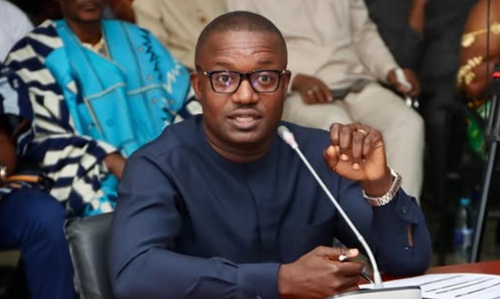
About 1,200 commercial operators within Burma Camp are set to begin paying for electricity following the withdrawal of a long-standing exemption previously extended to the Ghana Armed Forces.
The Minister of Energy, Mr John Abdulai Jinapor, disclosed this when he appeared before Parliament’s Government Assurances Committee on Tuesday, March 24, 2026.
He explained that the affected entities, including cold stores, barbering shops, washing bays and laundry services, had been operating without paying electricity and water bills, despite functioning as profit-making ventures within the military enclave.
Mr Jinapor noted that a significant number of those running the businesses were not active military personnel.
“Some of them were not even soldiers,” Mr Jinapor told the committee. “They set up businesses when they were soldiers and left. And you know the barracks, if you have a child, that child is almost supposed to stay in the barracks with you. So non-military persons also stay in the barracks. But unfortunately, those who are non military personnel are even more than the military personnel.”
He said a personal visit to Burma Camp informed his decision to terminate the blanket exemption on utilities for commercial activities, describing the move as politically challenging.
“I personally had to take a difficult political decision,” he said. “Until I came in, every electricity use in every barracks was totally free.”
The disclosure formed part of deliberations on a Cabinet directive issued in July 2025, which mandates the installation of prepaid meters across public institutions, subject to limited exemptions. The policy covers the Ghana Armed Forces, the Ghana Police Service, the Presidency, as well as public educational and health institutions.
During the hearing, members of the committee raised questions about the scope of exemptions, particularly whether agencies such as the Ghana National Fire Service, the Ghana Immigration Service and the Ghana Prisons Service were included.
The committee subsequently directed the Ministry of Energy to submit a comprehensive list of all exempted institutions before the close of business on March 24, 2026, to aid its report.
Nine months after the directive was issued, the committee said it was yet to determine the extent of implementation, including how many state institutions had been metered. The chairperson requested a written update from the minister on the same day.
On the broader metering programme, Mr Jinapor indicated that his administration inherited a significant shortfall in meters upon assuming office.
He attributed part of the challenge to procurement decisions by the Electricity Company of Ghana in 2024, when approximately GH¢9.3 billion was spent largely on cables, leaving meters and transformers in limited supply.
According to him, the procurement budget has since been reduced to GH¢1.8 billion and refocused on acquiring meters and transformers.
“I am happy to announce that we have taken delivery of a very good supply of meters and we have started releasing them,” he told the committee, adding that a nationwide transformer replacement exercise would commence before the end of March.
The committee also reviewed the status of the Self-Help Electrification Project, which requires beneficiary communities to provide poles and labour while government supports the rest of the installation.
Mr Jinapor said the model is no longer effective, as many communities are unwilling to provide unpaid labour.
“The communities will not do it,” he said, noting that some now demand payment for services that were originally intended to be voluntary. “Even though the name is self-help, it is funded fully by the government,” he told lawmakers.
Concerns were also raised about a cost-sharing practice where Members of Parliament use personal funds to accelerate electricity connections in their constituencies. One member disclosed funding connections for 25 communities, with 20 more pending.
Mr Jinapor acknowledged the practice but argued that it was unsustainable.
“MPs are already overburdened,” he said. “Government must look for that money to get electricity to the people so that MPs can use their limited money for other projects.”
