
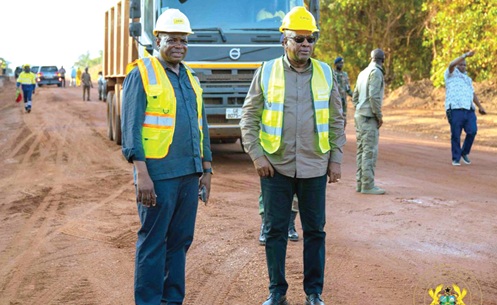
The Minister of Roads and Highways, Kwame Governs Agbodza, has disclosed that the government's flagship Big Push Infrastructure Programme is deliberately structured to prioritise Ghanaian contractors, with the aim of strengthening local technical expertise to keep investment within the domestic economy.
In an interview with the Daily Graphic, the Roads and Highways Minister explained that the programme, launched in 2025, represented one of the most ambitious road development efforts in the nation's history, with contracts worth more than GH¢63 billion awarded, estimated to create and/or sustain 490,000 jobs across the built environment.
Currently, 73 major road projects are underway across all 16 regions, covering over 1,700 kilometres.
They include priority projects such as the Kumasi Outer Ring Road, the dualisation of the Winneba-Cape Coast Road, the Tamale Third Ring Road and the construction of the Dambai Bridge in the Oti Region.
"The Big Push is not just about building roads. It is deliberately designed to build Ghanaian capacity," Mr Agbodza stated.
He added that the government was placing serious emphasis on Ghanaian contractors and workers because “we want to strengthen local technical expertise in the construction sector.
This is about ensuring that the benefits of infrastructure development remain within our economy."
The minister added that local companies supplying cement, bitumen, aggregates, transport, fabrication and equipment services were experiencing increased demand as a result of the programme.
Contractor selection
Mr Agbodza explained that in selecting contractors, priority was given to firms with proven track record, demonstrated capacity to mobilise quickly, proximity to project location, adequate financial strength and equipment availability.
"When we select contractors, we look at who can deliver quality work within stipulated timelines.
We give priority to those with the technical competence and operational readiness.
This approach ensures that local firms grow stronger with each project," he explained.
Mr Agbodza explained that the programme went beyond road construction to supporting economic growth and improving daily life across the country.
"Better roads mean shorter travel times, safer journeys, easier access to markets and stronger connections that support everyday economic life.
For commuters, traders and farmers across this country, these are not abstract benefits — they are tangible improvements that affect livelihoods," the Roads and Highways Minister told the Daily Graphic.
Transparency, procurement processes
When asked about concerns raised regarding transparency and procurement processes, Mr Agbodza defended the approach taken under the programme.
"All projects under the programme have been duly approved by Parliament as part of multi-year expenditure commitments.
All procurement processes have been conducted with strict adherence to the Public Procurement Act and its accompanying regulations," he stated.
Mr Agbodza acknowledged that a mix of procurement methods was employed, including 50 projects issued under commitment authorisation, 47 procured through single source procurement and seven through restricted tendering processes.
Additionally, 23 projects inherited from previous administrations where contractors were already on site, were absorbed into the programme.
"The use of restrictive tendering and sole sourcing was not arbitrary. It was necessitated by the urgency to resume stalled works, prevent cost overruns due to delays, and deliver critical infrastructure within compressed timelines.
These methods are explicitly permitted under our procurement laws under conditions of urgency and national interest," he explained.
Value for money
On whether the projects achieved value for money, the Roads and Highways Minister stated that independent value-for-money assessments had been conducted, which confirmed that project costs were commensurate with scope and engineering requirements.
He cautioned against over-reliance on simplified metrics such as “cost per kilometre” without considering contextual factors.
"Each project has unique characteristics. Costs are influenced by terrain and soil conditions, design specifications, traffic requirements, environmental and social considerations”.
“Asphalt overlay, for example, is fundamentally different from full reconstruction from subgrade to asphalt surface, or projects involving bridges, interchanges, drainage systems, and urban utility relocations," Mr Agbodza said.
The Roads and Highways Minister disclosed that Parliament approved GH¢13.8 billion for major road projects in 2025, while the 2026 Budget allocated an additional GH¢30 billion for strategic roads and bridges,
