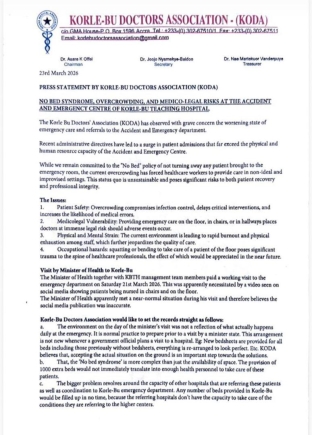
The Korle Bu Doctors Association (KODA) has issued a stark warning that the Accident and Emergency Centre of Ghana's premier teaching hospital is operating under conditions so compromised that both patient safety and the professional futures of its medical staff hang in the balance.
In astatement released on Monday, March 23, 2026, the association detailed a crisis it describes as far more complex than the "no bed syndrome" that has dominated public discourse.
The doctors warned that administrative pressures and a fractured national referral system have created an environment where emergency care is increasingly being delivered in hallways, on chairs, and on the floor—conditions they say expose clinicians to grave legal jeopardy.
'The law courts would not accept such a sacrifice'
KODA Chairman, Dr Asare K Offei, signed off on a statement that pulled no punches in its assessment of the dangers facing both patients and practitioners. While reaffirming the doctors' commitment to the "No Bed" policy; the principle that no patient should be turned away; the association made clear that the current trajectory is unsustainable.
"This status quo is unsustainable and poses significant risks to both patient recovery and professional integrity," the statement read.
The doctors issued a direct warning to their colleagues about the legal implications of working under such compromised conditions.
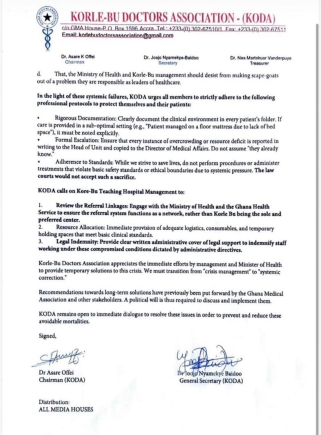
"The law courts would not accept such a sacrifice," the association cautioned, urging members to resist pressure to perform procedures or administer treatments that violate basic safety standards or ethical boundaries, regardless of systemic pressure.
KODA further instructed its members to engage in rigorous documentation of the clinical environment, explicitly noting when care is provided in sub-optimal settings such as floor mattresses due to lack of bed space. Every instance of overcrowding or resource deficit, the association said, must be formally escalated in writing to the Head of Unit and copied to the Director of Medical Affairs.
"Do not assume 'they already know,'" the statement warned.
Occupational hazards and human toll
Beyond patient safety and legal exposure, the doctors highlighted the physical and mental toll the crisis is exacting on healthcare workers. The association pointed to rapid burnout and physical exhaustion among staff, which it said further jeopardises the quality of care.
Particular concern was raised about the occupational hazards of providing emergency care on the floor. The doctors noted that repeatedly squatting or bending to attend to patients poses significant trauma to the spines of healthcare professionals—"the effect of which would be appreciated in the near future."
Minister's visit did not reflect reality
KODA's statement also addressed a visit by the Minister of Health, Kwabena Mintah Akandoh to the emergency department on Saturday, March 21, 2026, a visit reportedly prompted by a viral video showing patients being treated in chairs and on the floor.
According to the doctors, the minister encountered conditions that appeared near normal and subsequently suggested the social media publication was inaccurate.
KODA, however, offered a blunt rebuttal: "The environment on the day of the minister's visit was not a reflection of what actually happens daily at the emergency. It is normal practice to prepare prior to a visit by a minister of state. This arrangement is not new whenever a government official plans a visit to a hospital."
The association insisted that accepting the actual situation on the ground is an important step towards finding meaningful solutions.
Beyond beds: A national referral system in ruins
Perhaps the most significant dimension of KODA's analysis was its insistence that the crisis at Korle Bu cannot be solved by simply procuring more beds. The association argued that the "No Bed Syndrome" is far more complex than the availability of physical space.
"The provision of 1000 extra beds would not immediately translate into enough health personnel to take care of these patients," the statement said.
The doctors identified the root of the problem as the collapse of Ghana's referral system. Lower-level hospitals, they explained, lack the capacity to manage conditions they encounter, leading to a default practice of referring patients to Korle Bu.
"The bigger problem revolves around the capacity of other hospitals that are referring these patients as well as coordination to the Korle Bu emergency department. Any number of beds provided in Korle Bu would be filled up in no time, because the referring hospitals don't have the capacity to take care of the conditions they are referring to the higher centres."
KODA called on hospital management to engage with the Ministry of Health and the Ghana Health Service to ensure the referral system functions as a genuine network rather than a one-way funnel to Korle Bu.
Calls for legal indemnity and systemic correction
The association issued a series of demands to Korle Bu Teaching Hospital management, including an immediate review of referral linkages, the provision of adequate logistics and temporary holding spaces that meet basic clinical standards, and crucially, written administrative cover providing legal indemnity for staff working under compromised conditions dictated by administrative directives.
KODA also called on the Ministry of Health and hospital leadership to stop making scapegoats out of a problem they are responsible for as leaders of healthcare.
While appreciating the immediate efforts by management and the minister to provide temporary solutions, the doctors insisted that the focus must shift from "crisis management" to "systemic correction."
"Long-term solutions have previously been put forward by the Ghana Medical Association and other stakeholders," the statement noted. "A political will is thus required to discuss and implement them."
KODA concluded by expressing openness to immediate dialogue, stating that the goal is to prevent and reduce avoidable mortalities.
"The evidence is real. The crisis is real. And the response must be equally real," the statement concluded.