
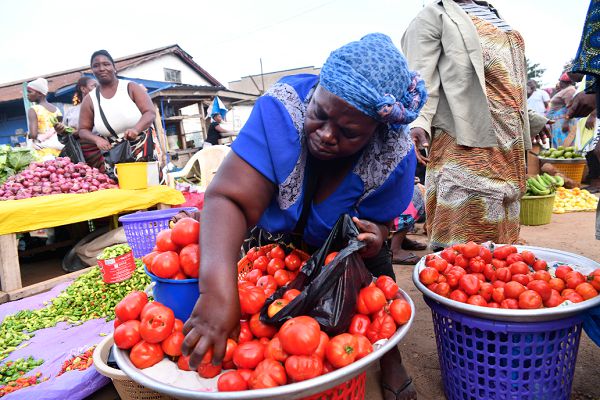
The Food and Beverages Association of Ghana (FABAG) has criticised Ghana’s agricultural policy direction, warning that the country’s reliance on imported tomatoes exposes deep structural weaknesses following a supply disruption triggered by a ban from Burkina Faso.
In a statement, the Association described the unfolding shortage as a failure of planning and leadership within the Ministry of Food and Agriculture, insisting that Ghana has the capacity to produce sufficient tomatoes domestically if the right measures are implemented.
“It is completely unacceptable that a country with vast agricultural land, irrigation dams, agricultural colleges, research institutions, extension officers, and a full Ministry of Food and Agriculture cannot produce enough tomatoes to feed its own population and must depend on another country for such a basic food commodity,” the statement said.
FABAG argued that the crisis highlights a long-standing dependence on imports for essential food items, despite the country’s natural and institutional advantages in agriculture. The group maintained that tomatoes, as a short-cycle crop, present an immediate opportunity for local production to close the supply gap.
“It is an agricultural fact, not a theory, that tomatoes can be produced within two (2) to three (3) months,” the Association stated, adding that “with irrigation and proper seed varieties, tomatoes begin harvesting within 60 to 90 days after planting.”
The Association warned that any inability to resolve the shortage within this timeframe would amount to a fundamental failure of the sector’s leadership and policy direction.
“Therefore, any claim that Ghana cannot solve tomato shortages quickly is simply an admission of policy failure, planning failure, and leadership failure,” the statement added.
FABAG further cautioned that continued dependence on external sources for basic food commodities poses a broader risk beyond agriculture.
“Depending on another country for a basic food item like tomatoes is not just an agricultural issue but a national security risk,” it said.
The Association insisted that Ghana possesses all the necessary resources to address the challenge, including fertile land, irrigation systems, trained farmers, research institutions and access to inputs such as seeds, fertilisers and mechanisation services. It stressed that the issue lies not in capacity but in coordination and execution.
“If after all these resources Ghana still cannot produce tomatoes to feed its people, then the problem is not farmers, not land, not climate, but the problem is leadership and policy direction,” the statement noted.
As part of its response, FABAG is calling for immediate intervention measures, including the declaration of a national emergency tomato programme, rapid distribution of improved seeds, subsidised agricultural inputs and the activation of irrigation systems to support dry-season farming.
The Association also urged the mobilisation of young people into commercial tomato farming, alongside investment in greenhouse production, storage facilities and processing plants to reduce post-harvest losses.
In addition, it proposed the setting of a clear national target for Ghana to achieve tomato self-sufficiency within one year, arguing that the current crisis should serve as a turning point for agricultural transformation.
FABAG concluded with a direct ultimatum to the sector’s leadership.
“If within two to three months the Ministry cannot organize tomato production under irrigation across the country, then the government must seriously consider restructuring the Ministry into a Production-Focused Agricultural Authority with clear targets and accountability.”
The statement underscored growing pressure on policymakers to move beyond strategy and deliver tangible results in food production, as supply disruptions continue to test Ghana’s agricultural resilience.
